
Osteria del Sole: Bologna's 1465 wine bar where you bring the food

Osteria del Sole is a wine bar and nothing more: it serves wine and beer, and you bring the food yourself. The osteria sits in Vicolo dei Ranocchi, a narrow lane a few steps from Piazza Maggiore and the Quadrilatero market streets, and it has occupied the spot since 1465. This guide covers what it is, how the counter-and-table system works, what to carry in, and who has drunk here.
Expect a spartan room rather than a restaurant: wooden tables and benches, a counter for the wine, and no kitchen. That is the whole appeal, and it has kept the place in local affections for five and a half centuries.
A wine-only osteria a few steps from Piazza Maggiore
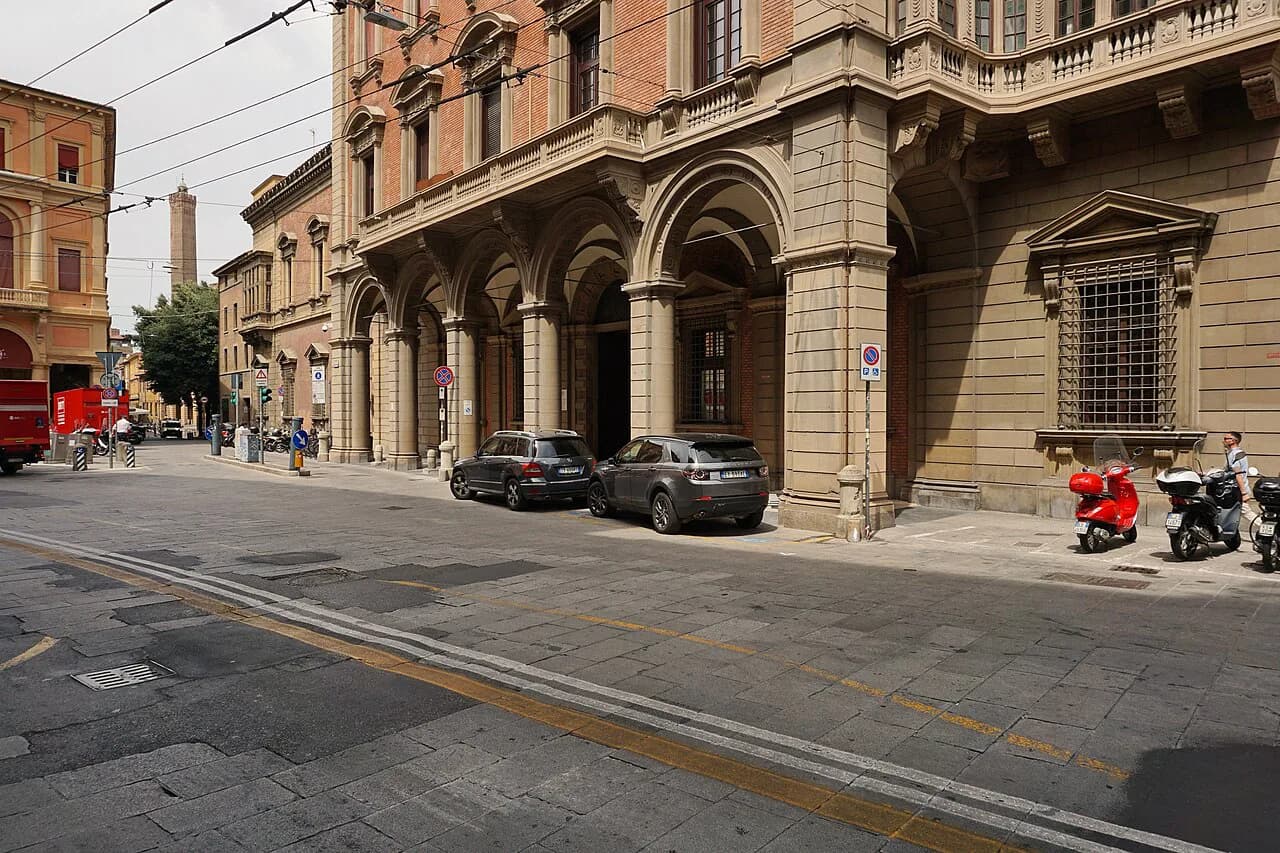
The osteria occupies Vicolo dei Ranocchi 1/D, a tiny lane that runs between Piazza Maggiore and the market streets of the Quadrilatero. The Biblioteca Salaborsa's history of the address describes it as a minuscule street two steps from the piazza, tucked inside Bologna's medieval quadrilateral near the Due Torri.
Inside, long tables run parallel to the walls, with benches and straw-seated chairs. You take a glass at the counter and sit wherever there is room, which on a busy lunchtime means sharing. The room has always been run on spartan lines, limited to pouring wine.
It is one stop within a wider eating plan for the city; browse our Bologna Attractions: 6 Visitor Guides if you want to place it alongside other food addresses rather than treating it as a sight.

The 1465 document and the Mitelli engraving
A document held in Bologna's State Archive records the osteria as present from 1465, when the Bentivoglio family governed the city. In Giuseppe Maria Mitelli's 1712 Gioco delle Osterie it appears as Il Sole nel stradello dei Ranocchi, noted in the game for good frittatas (omelettes).
The sign reproduced in Mitelli's engraving was later recovered and adopted as the osteria's trademark. In earlier centuries the place gave shelter and refreshment to pilgrims and to relatives of patients at the nearby Ospedali della Vita e della Morte.
The osteria's own account puts it among the oldest osterie in the world, with its first documents dated to 1465. One Bologna city magazine goes further and calls it the second oldest in Italy, behind the Brindisi in Ferrara, which it dates to 1435; the superlatives are best treated loosely.

How it works: wine at the counter, then find a seat
You order and collect drinks at the counter, then sit where you can at the communal tables. The house rule is stated plainly on its own site: they provide the wine, you provide the food.
The drinks list is wine and beer, with no soft alternatives offered. That is worth knowing before you arrive with someone who wants a coffee or a water, because the osteria is set up around the glass in front of you.
Because there is no table service in the restaurant sense, the rhythm is unhurried: you fetch, you sit, you talk. Budget around an hour for a plate of shopping and a glass, longer if you settle in.
The food rule: buy it in the Quadrilatero and carry it in
The osteria serves nothing to eat, so the meal comes from the shops around the market. The Biblioteca Salaborsa notes that customers buy food in the wealthy shops of the Quadrilatero and carry it to the osteria, a practice the city calls al scartoz, the paper cartoccio of sliced salume and cheese.
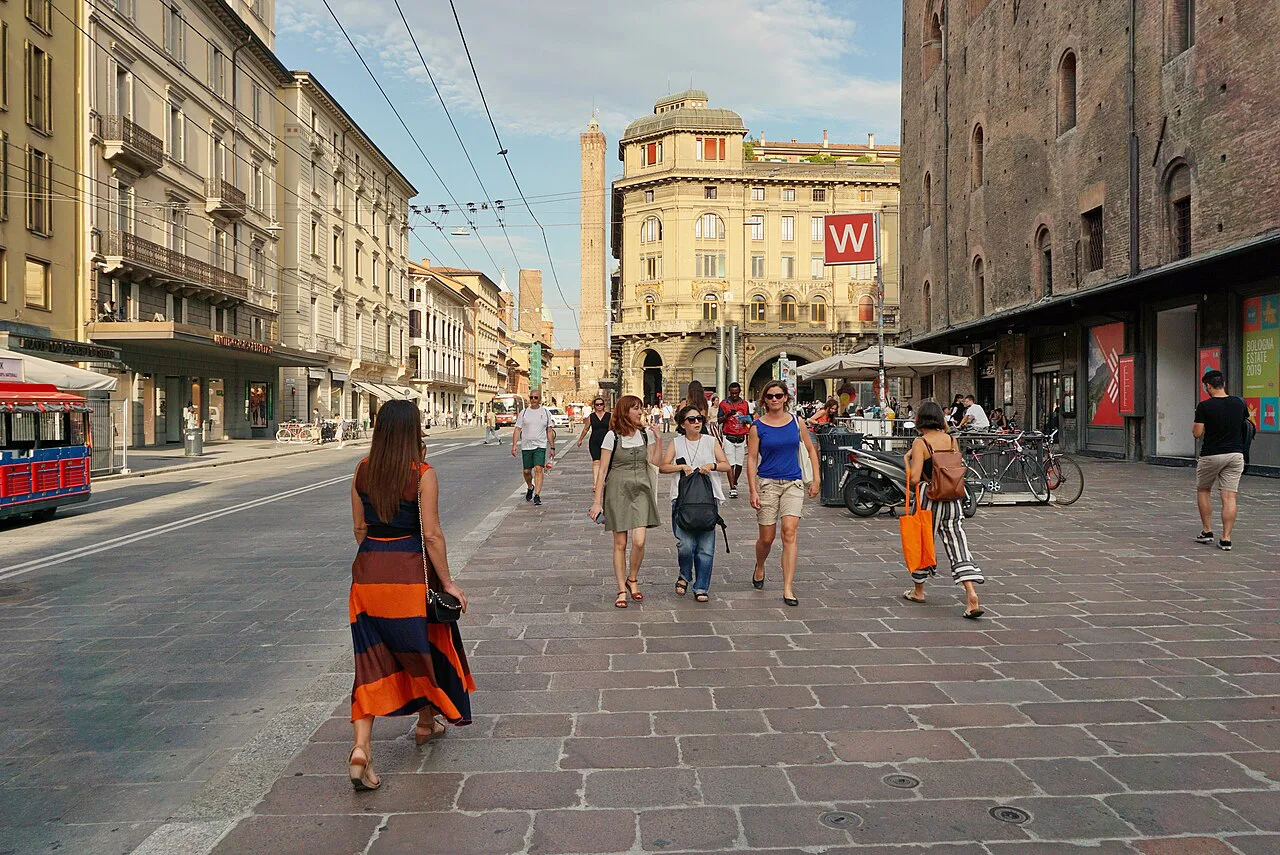
The Quadrilatero is the grid of lanes between Piazza Maggiore and Via Rizzoli, and it is where you assemble the food: a salumeria for cured meat, a cheese counter, a bakery for bread. Plan the shopping before you claim a table, because leaving your seat to forage at peak time is awkward.
For sliced cured meats and a proper counter, Antica Salumeria Tamburini is the established name in the neighbourhood and a sensible first stop.
If you would rather graze than build a picnic, Mercato di Mezzo, the covered market hall nearby, has stalls where you can pick up a portion or two on the way.
Getting there and when it fills up
From Piazza Maggiore, walk into the lane beside the market streets and you are there in a couple of minutes; the address is Vicolo dei Ranocchi 1/D. Bologna's medieval centre is compact and pedestrian, so the osteria is an easy walk from the Two Towers and the university quarter.
The osteria takes bookings by phone, listed on its site for information and reservations. It fills around lunchtime with market shoppers and students and stays busy into the evening, so call ahead if you want a table rather than a perch.
Its published hours run Monday to Saturday from 11.00 to 21.30, with Sunday from 12.00 to 16.00.
Poets, students and the Bab Ilu crowd
By 1878 the osteria was a haunt of young socialist and internationalist students under police surveillance, and Giovanni Pascoli was among them. On 9 July 1878 a meeting there moved to found the Bolognese Federation of the International, and Pascoli was proposed as secretary for foreign correspondence, a post he declined.
In the 1960s a different generation took over the benches: the poets around the avant-garde magazine Bab Ilu, founded by Adriano Spatola, drank at the Sole along with the Poeti and the Moretto. The literary history is a large part of why the room matters to Bologna.
Drinking plainly, and where to go next
This is a place for a glass or two of wine with your food, not a session. The wine is poured simply and the atmosphere is convivial: you order at the bar, carry your glass to a bench, and eat what you brought.
Afterwards, walk the few minutes to Caffè Terzi in Bologna for a coffee, which makes a clean end to a meal built on cured meat and bread.
If you want something sweet to take away instead, Pasticceria Gamberini is a nearby pasticceria worth a stop.
Is Osteria del Sole worth the detour?
Yes, if you want a piece of Bologna's history with a glass of wine and are happy to assemble your own lunch. It is cheap in spirit and generous in character, and the ritual of buying food in the Quadrilatero and carrying it in is the point, not an inconvenience.
Skip it if you want a served meal, a full menu or a quiet table to yourself. For the rest, ring ahead, arrive before the lunchtime rush, and bring a cartoccio.