Pastry Shops in Trieste: Which Sweet Classic to Try
Trieste's pastry shops serve mitteleuropean cakes with coffee. Here are the pasticcerie to know, the sweets to order and how the city eats them.
On this page
Four pastry shops in Trieste are worth building a morning around: La Bomboniera in via XXX Ottobre, Pirona in Largo Barriera Vecchia, Penso in via Diaz and Liberty in Via Carpison. The first three are historic addresses listed by the city among its caffè storici, while Liberty is a modern artisan laboratory on the edge of the centre. This guide explains what each one is, which sweet to order there and how the counter-and-coffee routine works.
Trieste's pastry case is not Italian in the way most visitors expect. The city's historic pasticcerie were founded under Austro-Hungarian rule and still bake the cakes of that inheritance: Sacher, Linzer, dobos, Rigojansci and the local presnitz and putizze. Knowing the vocabulary before you point at the glass makes the whole stop easier, so each term is translated once as it comes up.
Which pastry shops in Trieste are worth your time
Start with La Bomboniera if you want one stop that sums the city up, Pirona if you want a Liberty-style room with literary history, and Penso if you want an old counter away from the main visitor streets. Liberty suits a later, quieter pause on the walk between the centre and the station quarter. The heart of the centre is small enough to fold a pastry breakfast into a morning before moving on to the best restaurants in Trieste for lunch.
La Bomboniera is the smallest of the group, with a handful of indoor tables and a terrace that only works in good weather, according to visitor reports on the local directory page. That matters on a rainy morning, when a sit-down breakfast for four is a squeeze. If you want a table rather than a box, aim for a weekday or arrive knowing you may be standing.
The addresses spread across the centre rather than clustering in one street, so plan a route rather than a single destination. Via XXX Ottobre and Largo Barriera Vecchia sit within a few minutes of each other; via Diaz and Via Carpison pull you in different directions. Trieste rewards a short walk between counters, and a second stop in one morning is easy to justify.
La Bomboniera: the 1850 pasticceria with the original wood-fired oven
The Comune di Trieste dates La Bomboniera's founding to 1850, when the Hungarian Eppinger family opened it in via XXX Ottobre. The city's heritage itinerary notes that the shop kept its original wood-fired oven, described as one of very few still in use in Italy, along with its Liberty-style fittings and windows. Baking in that oven is part of how the shop presents itself.
The same itinerary explains that Austro-Hungarian sweets, mainly Austrian and Hungarian, are baked on request, and that a Hungarian pastry chef, Giuseppe Poth, arrived in the 1930s. Take the comune's account as the shop's stated tradition. For a visitor, it means the case leans to the cakes of Vienna and Budapest rather than to Italian cream pastries, and the original wood-fired oven and Liberty-style furnishings are part of the appeal.
Walking in, expect a tight little room rather than a café with room to spread out. A boxed selection is the efficient move if you want to try several cakes without committing to a table, and visitor reports note a separate takeaway queue at busy times.
What to order at La Bomboniera: presnitz, putizze and torta carsolina
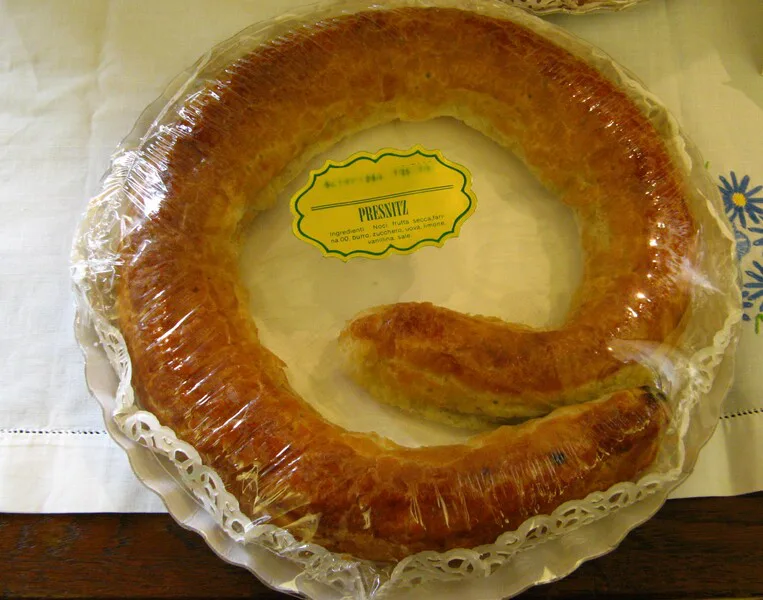
Presnitz is a rolled pastry spiral filled with nuts, honey and dried fruit, sliced thin like a salami and sold by weight; it is the most Triestine thing in the case. Putizze are small, sticky fruit-and-nut sweets more often bought in a box than eaten at the counter. Torta carsolina is a layered cake of the Karst hinterland, dense with nuts and honey, and a good yardstick for how a shop handles the local repertoire.
From the Austrian side, order Sacher for the apricot-and-chocolate benchmark, Linzer for the spiced jam sandwich and dobos for a layered sponge topped with caramel. Rigojansci is the rum-and-chocolate Hungarian cake to try if you only have room for one more. A review on the local directory recommends ordering several different cakes and sharing them as a collective tasting, which is sensible given the portion sizes.
Buy presnitz and putizze by weight to take home rather than eating them at a table; they travel better than cream cakes. If you are eating in, pick one slice and one coffee, then add a biscuit or a small pastry from the counter. Portions are generous, so a second round is easy to add once you have a seat.
Pirona: a Liberty-style pasticceria open since 1900
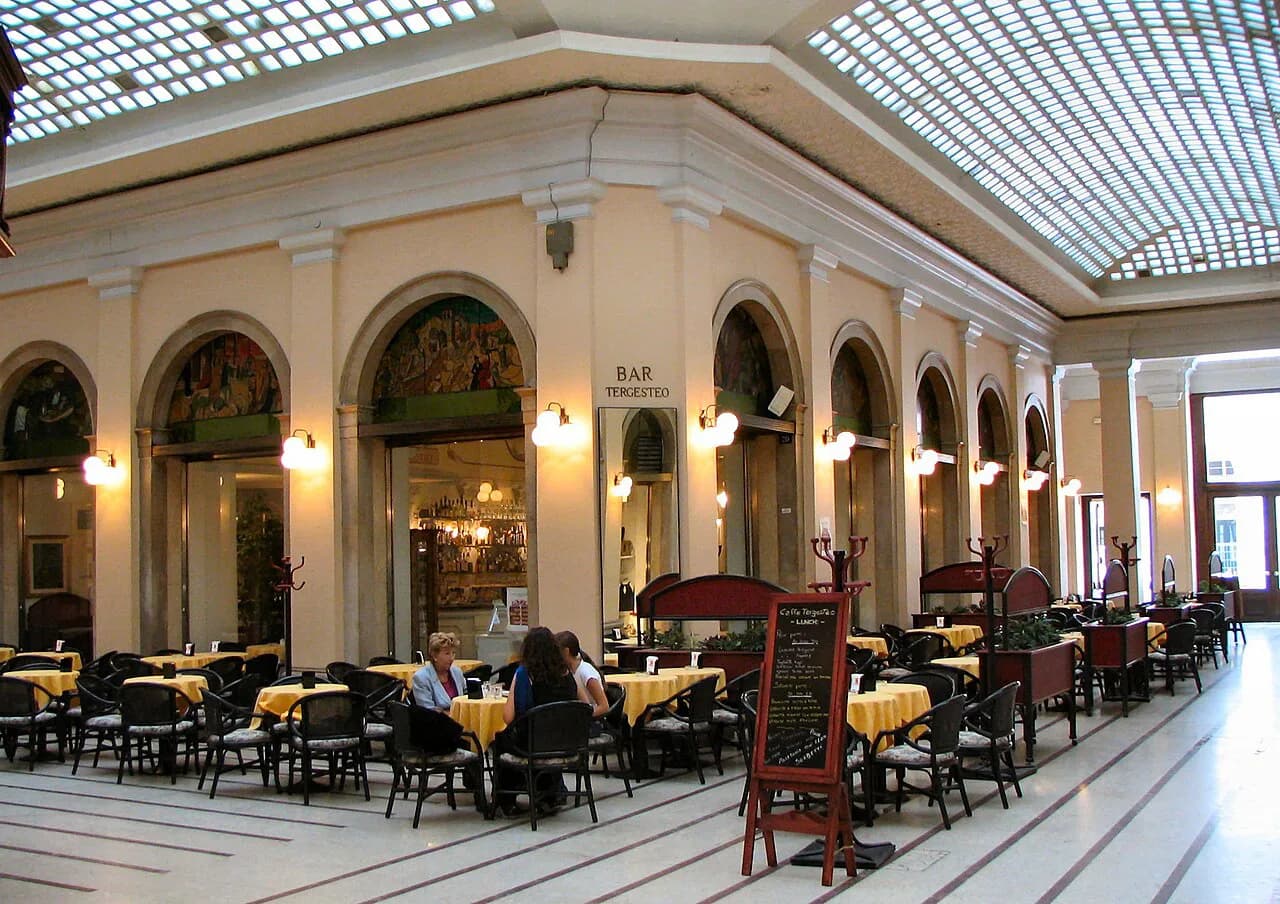
Alberto Pirona opened the shop in Largo Barriera Vecchia in April 1900, and the city itinerary records that the original fittings survive, including the Liberty stained glass and the wooden shelves stacked with Triestine sweets. The portrait of James Joyce on display is there because the Irish writer lived nearby and was a regular. That double history, design and literature, is why Pirona sits on the city's official caffè storici route.
Pirona is the pick if you want to sit in a period room rather than eat standing, and the neighbourhood is quieter than the streets around the main square. Order from the Triestine range as you would at La Bomboniera, with a coffee to follow, and treat the room itself as half the reason for coming. A first stop here fits neatly into a slow breakfast in Trieste before the city fills up.
Pasticceria Penso and the mitteleuropean cake counter
Penso in via Diaz has sold Triestine and mitteleuropean cakes since 1918, according to the same city itinerary. It is the plainest of the three historic names, and that is its appeal: a working pasticceria where the cake case does the talking. Come here when you want the same repertoire as La Bomboniera without the crush of a landmark.
The cakes overlap across all three shops, so the choice between them is about atmosphere and queue length rather than radically different menus. Penso suits a quick counter stop with a box for later; La Bomboniera suits the full ritual even at the cost of space; Pirona suits a seated pause. Buy one slice plus a boxed presnitz and you have covered both.
Pasticceria Liberty: a modern artisan laboratory in Via Carpison
Liberty describes itself as a pasticceria, artisan laboratory, delicatessen and cookery school rolled into one, with pastry chef Lisa Angelini choosing and tasting every ingredient from flour to butter, jams to creams. Seasonality is explicit: the shop says it uses fruit only in season and favours local produce. That makes it the counter to watch for what is fresh rather than what is traditional.
It also runs cookery classes, including sessions for children, built around working together rather than watching a demonstration. For a visitor, that means the laboratory side is visible in what is on the counter, and the range shifts with the season rather than staying fixed to a heritage list. It is a useful contrast to the 1900-era rooms further into the centre.
Liberty lists takeaway among its services, so it works well for a box to eat later or a picnic on the seafront. The address is Via Carpison 7/C, a short walk from the centre and slightly off the main visitor track. The shop publishes a reservation line on +39 040 2460879, worth using if you are coming as a group.
The cakes that define Trieste's pastry case
The shared vocabulary is worth learning once. Sacher is a chocolate sponge with a thin apricot layer and a dark glaze, Linzer a spiced shortbread sandwich with jam, dobos a many-layered sponge with caramel on top, and Rigojansci a rum-and-chocolate cake. These are the Austro-Hungarian cakes the city's pasticcerie inherited, and they appear on counters across the centre.
The local layer is what separates Trieste from Vienna. Presnitz and putizze come from the city and its Karst hinterland, torta carsolina from the plateau behind it, and Pischinger adds a chocolate-hazelnut wafer cake to the list. If you have one pastry stop, order one Austrian cake and one local sweet together.
Bread and savoury baking belong to the same counter culture, which is useful if not everyone in your group wants sugar. Trieste's bakeries double as pasticcerie in several cases, and a slice of something savoury with a coffee is a normal mid-morning order. Keep a boxed selection for the train or the walk back.
How Trieste takes its coffee, and why it comes with a glass of water
Coffee in Trieste arrives with a small glass of water and, at La Bomboniera, a little shot of hot chocolate on the side, as several visitors describe it. The water is there to clear your palate between sips; the chocolate is a house gesture rather than a menu item. Treat them as part of the service.
Standing at the bar is the fast option: order, drink and go, and the whole stop can take five minutes. Sitting at a table costs more in most Italian cafés and takes longer, but the historic rooms are the reason to choose it here. If you want a proper pause, sit; if you have a train to catch, stand.
The coffee names are local and worth knowing before you order. A nero is a small black coffee served in the classic little cup, and asking for a caffè gets you the standard espresso. Use the local wording and you get exactly what you meant.
Sitting down or taking away: which suits your day
Choose the counter when you want speed: order, eat standing and settle up as you leave. Choose a table when the room is the point, as at Pirona or the small front room at La Bomboniera, and accept that service slows down when the shop is full. For a group of four on a wet day, the standing option is often the only one that works.
Takeaway is the third route, and the one locals use most for cake. Ask for a box and buy presnitz or putizze by weight rather than by the slice; they keep for days and survive a train journey. At La Bomboniera there is a separate takeaway queue, so join the right line from the start.
Pair a pastry stop with the rest of the day's eating rather than treating it as a full meal. A slice and a coffee at ten leaves room for a proper lunch, and cheap eats in Trieste are easy to find in the same central streets. If you are walking the centre afterwards, keep the box for a bench rather than a table.
Booking, queues and the small dining rooms
Liberty publishes a reservation line on +39 040 2460879, where the point is to secure a table for a group rather than to skip a queue. At the historic shops expect the queue to be the system: you wait, order and eat, and plan the wait into your morning.
Space is the real constraint at La Bomboniera, where visitor reports describe a couple of small indoor tables and a terrace that depends on the weather. That is the trade-off against its history and its oven: the most atmospheric stop is also the hardest to sit down in. If comfort matters more, Penso or a quieter hour at Pirona is the better call.
Small notes are easier at a busy counter than a card. The pastry stop is a small spend, so keep a few euros handy. For everything else in the city, the best pizza in Trieste is a different kind of queue entirely.
Which pasticceria should you choose?
Pick La Bomboniera for the single most Triestine experience, oven and all; Pirona for a Liberty room and a slower seat; Penso for the same cakes with fewer people; Liberty for a modern, seasonal counter and a box to take away. Two of them in one morning is a reasonable pace, and one is enough if you are heading on.
Order one Austrian cake and one local sweet, take your coffee standing if the room is full, and buy presnitz by weight for the journey home. That covers the pastry case of Trieste without turning it into a checklist.
Explore more Trieste food guides
Frequently Asked Questions
Do I need to book a table at Trieste's historic pasticcerie?
No. The historic shops work on a queue-and-order basis, with no booking system; you wait at the counter or for a table and are seated as space frees up. Space inside the smallest rooms is limited, so a weekday morning is easier than a weekend. Booking by phone is worth doing only at Pasticceria Liberty, which publishes a number for reservations.
What is the difference between presnitz and putizze?
Presnitz is a rolled pastry filled with nuts, honey and dried fruit, sliced thin and sold by weight. Putizze are small, sticky fruit-and-nut sweets, usually bought in a box rather than eaten at the counter. Both are local Triestine sweets rather than the Austrian cakes that dominate the case.
Can I buy cakes to take home from Trieste?
Yes. Ask for a box at the counter; presnitz and putizze travel and keep better than cream cakes and are sold by weight. At La Bomboniera there is a separate takeaway queue, so join that line rather than the one for tables.
Sources
Notes for your next meal in Italy
Optional updates to our food guides.
You might also like
Continue reading
More guides you'll find useful