Neapolitan Pizza: What Makes It Different and How to Spot It
Neapolitan pizza is a hand-stretched, wood-fired pizza baked in 60 to 90 seconds. Here are the AVPN rules that define it and the signs to look for.
On this page
Neapolitan pizza is a round, hand-stretched pizza with a puffed rim, a thin centre and a bake of just 60 to 90 seconds in a wood-fired oven. It is defined by technique as much as by topping, which is why a Margherita in Naples and a Margherita elsewhere can behave completely differently on the plate. This guide walks through the ten rules the Associazione Verace Pizza Napoletana uses to recognise a vera pizza napoletana, then turns them into things you can actually see, smell and taste in a pizzeria.
What Neapolitan pizza is, in one paragraph
It is an artisanal product, so the association's own decalogue opens by accepting that it will vary slightly from pizzeria to pizzeria. The constants are a dough of water, salt, yeast and flour proved for at least eight hours, a disc stretched only by hand, and a wood-fired bake measured in seconds rather than minutes. Everything else, from the puffed rim to the wet centre, follows from those three decisions.
The AVPN decalogue: the ten rules that define a vera pizza napoletana
The decalogue runs through the pizza as a whole: the pizza itself, the dough, the stretching technique, the products, the cooking, the cooking quality, the appearance, the aroma, the taste and harmony, and the nutrition of the finished dish. Read as a set, the rules describe a light, moist, quickly baked pizza rather than a crisp one that sits on a tray. That distinction is the single most useful thing to carry into a pizzeria.
How is Neapolitan pizza pronounced? In English it is usually said as nay-uh-POL-ih-tun, with the stress on the second syllable. In Italian, napoletana is pronounced nah-po-leh-TAH-nah, which is the word you will see on signs and menus around Naples.
Can you make Neapolitan pizza in a home oven? Only approximately. A domestic oven topped out at its maximum heat with a stone inside gets close enough to colour the base and puff the rim, but it cannot match the 60 to 90 second bake of a wood-fired oven.
Is Neapolitan pizza wet in the middle? Yes, and that is intended. The short bake leaves the centre moist and foldable, which is why the standard describes the pizza as easy to fold into a libretto, a little booklet.
For orientation across the wider subject, from Roman styles to regional toppings, the Italian pizza guide fills in the family tree around this Naples standard. Neapolitan is the soft, fast-baked end of it.
The dough: four ingredients and at least eight hours of proving
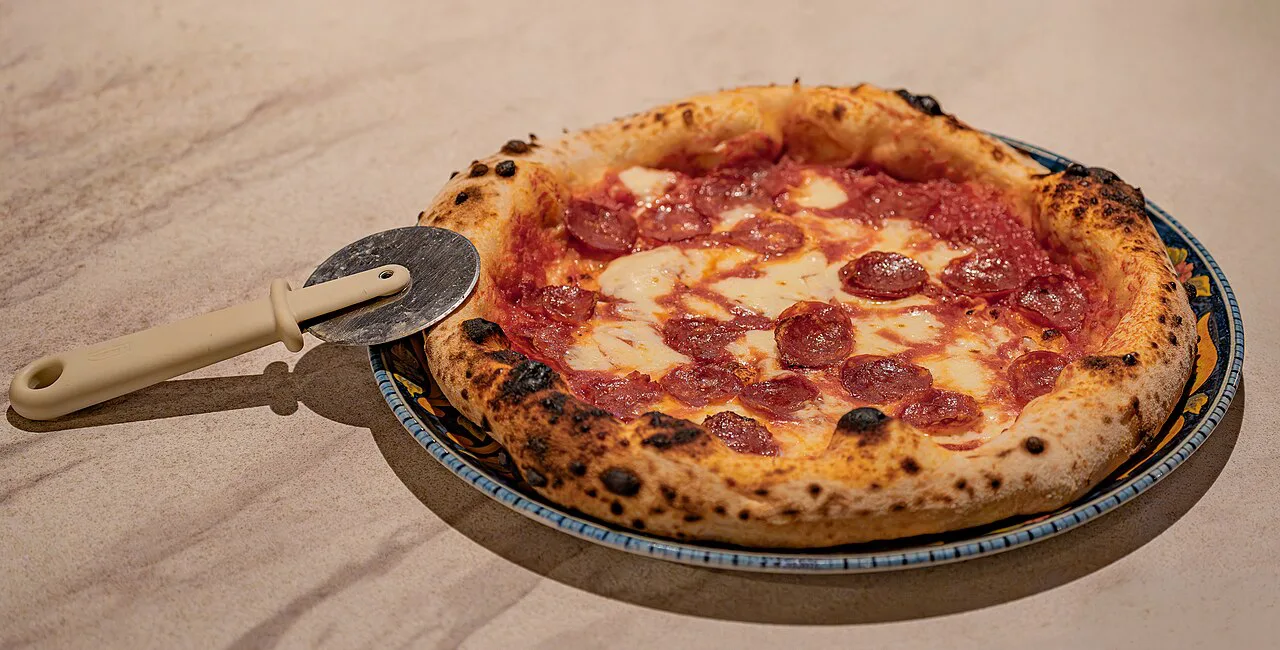
The dough contains only water, salt, yeast and flour, and the association requires it to prove for at least eight hours. That long rest is what develops the flavour and the extensibility you feel when the base folds rather than cracks. A pizzeria that rushes this stage tends to produce a base that looks right but tears or goes leathery at the table.
The ingredients are deliberately few, so the flour and the proving do most of the work. Home bakers chasing the same texture usually find hydration is the variable that matters most, with a wetter dough giving a softer, airier result.
Hand-stretching and the puffed cornicione
The disc of dough is stretched exclusively by hand, and the method pushes air from the middle outwards so the edge stays puffy and rises into the cornicione, the raised rim. A rolling pin flattens exactly the air pocket the style depends on. When you pick up a slice, the rim should feel hollow and light rather than bready and dense.
Toppings on a Neapolitan pizza
Products are preferably from Campania: hand-crushed peeled tomato that stays chunky, buffalo mozzarella sliced or fior di latte, meaning cow's milk mozzarella, cut into strips, fresh basil laid on top, and extra virgin olive oil poured in a spiral. Grated cheese, if used, goes on in a circular sweep of the hand. Margherita and Marinara are the reference points, but other toppings are allowed provided they meet the association's regulation and fit Italian gastronomy.
That permission matters when you are choosing from a menu: a Quattro Stagioni or a Quattro Formaggi can still be a proper Neapolitan pizza if the base and the bake are right. Judge the dough and the oven first, then the topping.
The wood-fired oven and the 60 to 90 second bake
The pizza must be cooked in a wood-fired oven, not on a baking pan, for 60 to 90 seconds. That short, fierce bake is what gives the rim its blistered colour while leaving the centre soft enough to fold. A domestic oven cannot reproduce it, so the home version is necessarily an approximation built on a preheated stone and the highest heat the oven will give.
How to judge the bake: the foldable libretto
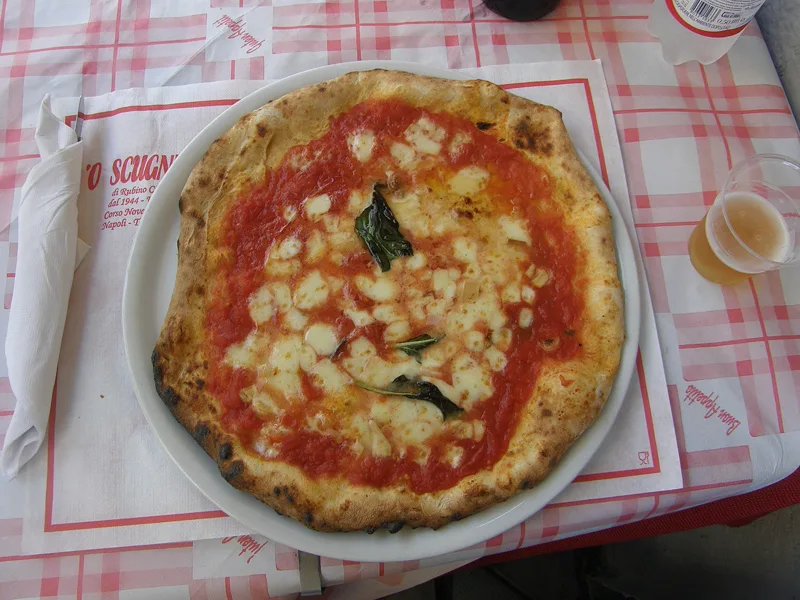
The association is unusually specific about what a good bake looks like. The pizza should fold easily into a libretto, a little booklet, the crust should stand 1 to 2 cm high and be even and puffed up, and the diameter should not exceed 35 cm with a centre no more than 4 mm thick. Colour should be golden with very few burns and bubbles.
Two failures are easy to spot at the table. A pale, limp rim suggests the oven was not hot enough, while a centre thick enough to resist folding suggests the dough was overworked or undershaped. If you lift one side and the underside is golden without heavy charring, the bake was controlled.
What it should smell and taste like
Straight from the oven, a Neapolitan pizza should smell of baked bread, with a slightly acidic note from the tomato and mozzarella and something fruity and spicy from the oil and garlic. Basil and oregano add a fresh, grassy edge to the aroma. On the palate the flavours should be intense but balanced, the savoury mozzarella and sweet tomato held in check by the bitterness of the oil.
This is where generous toppings work against the style. A heavy hand with cheese or cured meat smothers the bread aroma the bake is designed to produce, so a short topping list is usually a sign of confidence rather than laziness. A drizzle of good olive oil at the end does more for the balance than another layer of anything else.
Neapolitan pizza versus Margherita: the style versus the topping
This is the most common confusion in the English-speaking world. Neapolitan describes a style of dough, shaping and baking, while Margherita describes a set of toppings: tomato, mozzarella, basil and oil. A Margherita can be made in the Neapolitan style or in a quite different one.
In practice, ordering a Margherita in a Neapolitan pizzeria tells you very little you did not already know from the oven. Ordering a Marinara, which skips the cheese entirely, is often the sharper test because there is nowhere for a weak dough or a careless bake to hide.
Neapolitan pizza versus other Italian pizza styles
The contrast most travellers meet first is with pizza al taglio, the rectangular tray-baked pizza sold by weight in Rome and elsewhere, which is crisp, oilier and designed to be eaten standing or walking. Neapolitan is the opposite: whole, soft, wet in the middle and best eaten immediately with a knife and fork. Neither is the correct Italian pizza; they are different formats for different occasions.
If you want a sit-down round pizza with a thin, crackling base, the Roman pizza guide is the closer reference point, since pizza tonda in Rome is baked longer and comes out firmer and more brittle than its Neapolitan cousin. For the tray-baked slice, see our Roman Pizza guide.
Calories: about 800 for a Margherita, about 550 for a Marinara
The association gives indicative energy values based on a 250 g ball of dough: roughly 800 kcal for a Margherita and roughly 550 kcal for a Marinara. The gap between them is essentially the mozzarella. The decalogue frames pizza as part of the Mediterranean diet rather than as an indulgence outside it, which is a fair way to plan a meal around one.
Ordering and eating Neapolitan pizza in a pizzeria
Order the pizza you actually want, but order it one per person and expect it to arrive fast; a 60 to 90 second bake does not wait for a table to finish its starter. Eat the middle with a knife and fork while it is hot and pick up the rim with your hands, folding it if you like. A pizza that has gone cold is no longer showing you what the pizzaiolo, the pizza maker, intended.
A short menu built around Margherita, Marinara and a handful of others is the strongest signal that a kitchen is focused on the bake rather than on assembling ingredients. Beyond that, judge what is in front of you against the fold, the puffed rim and the golden underside.
Which pizza should you order first?
Start with a Marinara or a Margherita. They are the two pizzas the Neapolitan standard is written around, and they expose the dough and the bake before any topping can cover for them. If the rim is puffed and blistered, the centre folds without tearing and the underside is golden, the pizzeria is doing the important things right.
After that, work through the menu with the style as your filter rather than the toppings. A Quattro Stagioni from a good oven will beat a Margherita from a careless one, and understanding why is the whole point of learning the rules.
Explore more Italy food guides
Frequently Asked Questions
How is Neapolitan pizza pronounced?
In English it is usually said as nay-uh-POL-ih-tun, with the stress on the second syllable. In Italian, napoletana is pronounced nah-po-leh-TAH-nah, which is the word you will see on signs and menus around Naples.
Can you make Neapolitan pizza in a home oven?
Only approximately. A domestic oven topped out at its maximum heat with a stone inside gets close enough to colour the base and puff the rim, but it cannot match the 60 to 90 second bake of a wood-fired oven. Expect a slightly firmer, less blistered result and treat it as a good home pizza rather than a replica.
Is Neapolitan pizza wet in the middle?
Yes, and that is intended. The short bake leaves the centre moist and foldable, which is why the standard describes the pizza as easy to fold into a libretto, a little booklet. If the middle is dry and rigid, the pizza has been baked too long or made with too little moisture.
Sources
Notes for your next meal in Italy
Optional updates to our food guides.
You might also like

Continue reading
More guides you'll find useful