Roman Pizza: What It Is, the Two Styles and Where to Eat It
Roman pizza means two things: the thin, crisp tonda eaten at a table and pizza al taglio sold by weight. Here is what each one is and where to eat it in Rome.
On this page
Roman pizza means two different things, and knowing which one you want changes how you order. The first is pizza tonda, a thin, crisp round pizza eaten at a table; the second is pizza al taglio, baked in large trays, cut with scissors and sold by weight from a counter. This guide explains the difference, names the Roman toppings worth asking for, and points you to specific forni and pizzerias across the city.
If you have a picture of a blistered, puffy crust from Naples, reset it. Roman pizza is flatter and crunchier, built for eating fast while standing up or for sharing at a modest table, and it fits easily into a lunch break between sights.
What Roman pizza is: the thin, crisp base
Roman pizza is a thin, crisp style that sits at the opposite end of the spectrum from the soft, high-edged Neapolitan pie: for the other great Italian tradition, see our guide to Italian Pizza, and for the puffy original, Neapolitan Pizza. The base is rolled or stretched flat and baked until it crackles under the tooth, with a firmness that holds up well when it is cut into squares and sold over a counter. That crispness is the defining trait: it keeps a tray pizza from going soggy under wet toppings, and it makes a plain slice with olive oil and salt genuinely satisfying.
The dough is typically a simple flour, water, salt and yeast mix, and La Cucina Italiana describes one bakery using a 120-year-old starter, which gives you a sense of how seriously leavening is taken here. When you buy it by the slice, you are eating bread as much as pizza, which is why many of the best versions come from forni (bakeries) rather than from a pizza restaurant.
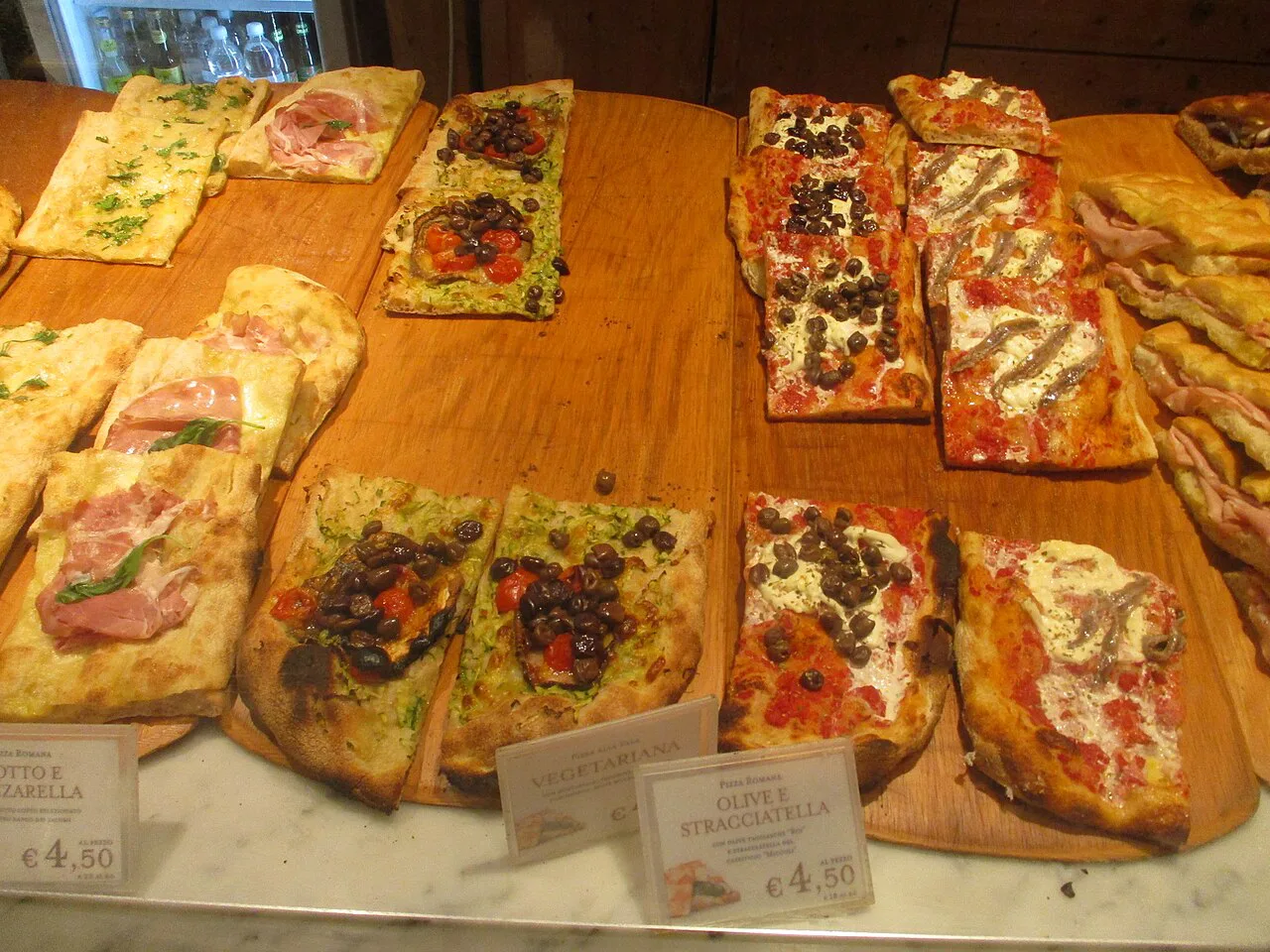
The two styles: pizza tonda and pizza al taglio
Pizza tonda is the round, whole pizza ordered at a table, usually from a sit-down pizzeria in the evening. It arrives on a plate, already cut into wedges, and is eaten with a knife and fork or by hand depending on the house. It is the format for a proper dinner, and it is where you find the Roman-invented combinations, such as the carbonara pizza described below.
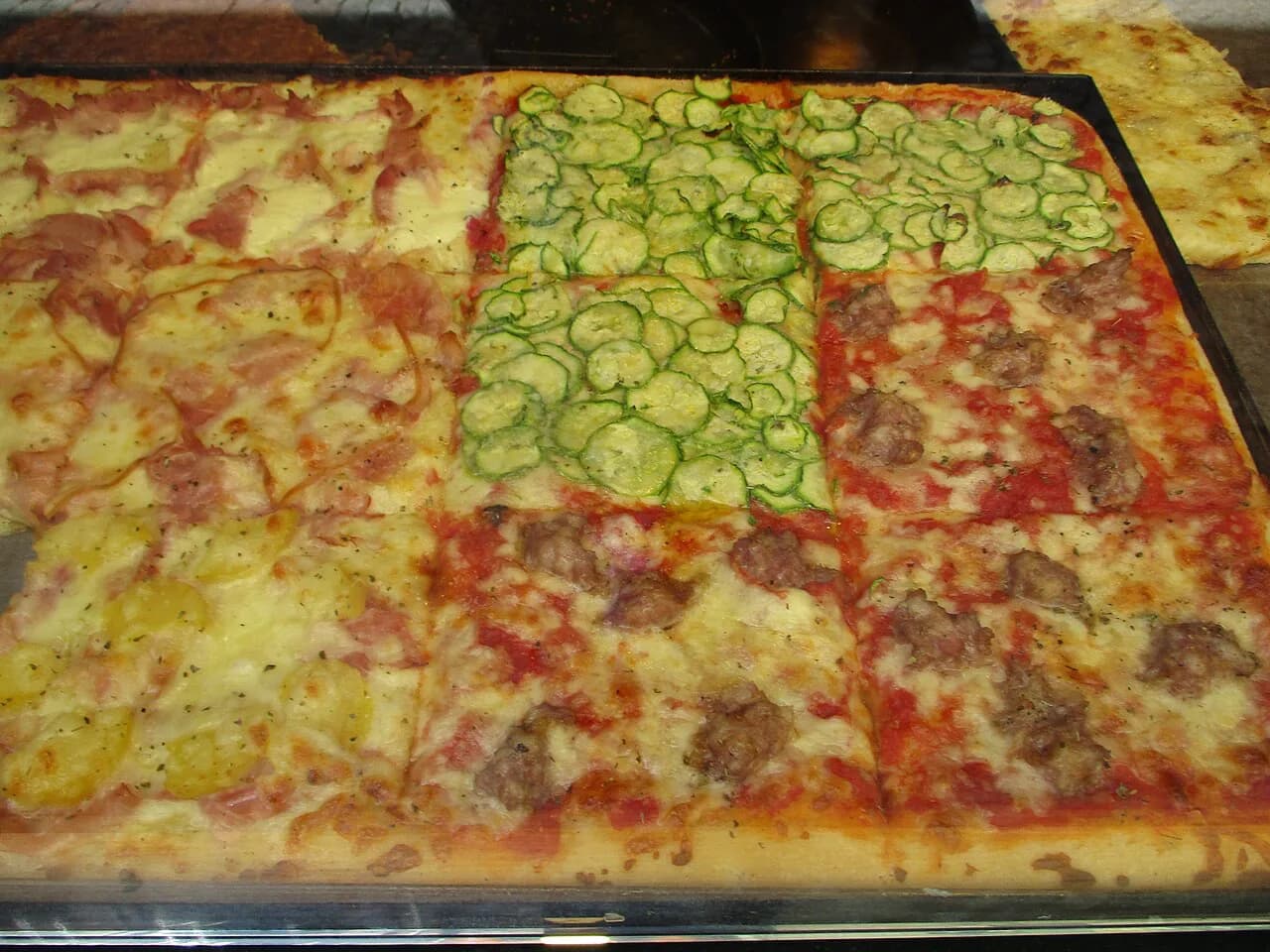
Pizza al taglio is baked in rectangular trays, displayed behind glass, and sold by weight or by the piece. You point at what you want, the server weighs or cuts it, and you pay at the counter. The two styles share a dough tradition but not an occasion: one is a meal, the other is lunch, a snack or a cheap early dinner eaten standing up or on a nearby wall.
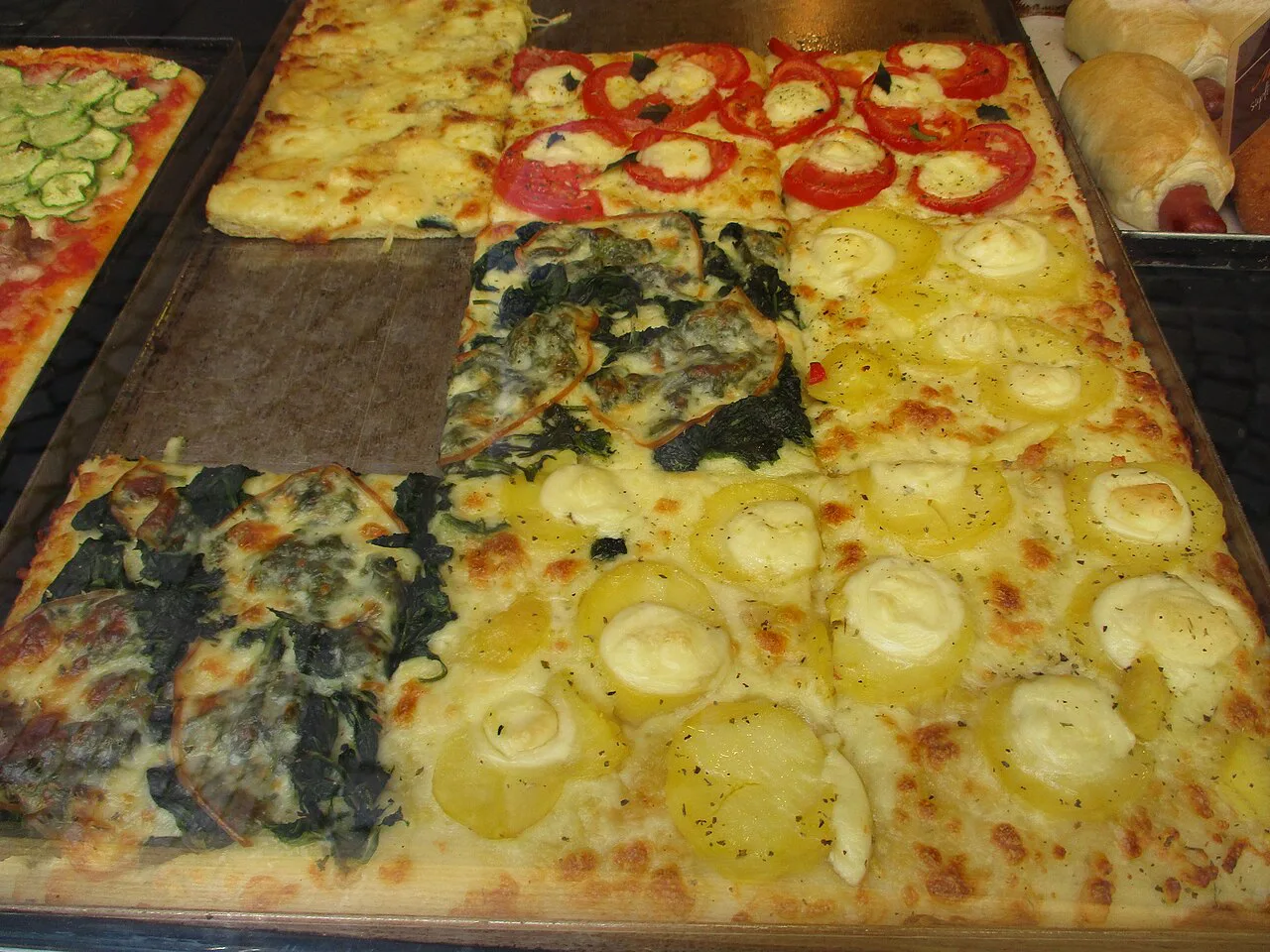
Pizza al taglio: how it is priced and sold by weight
At a taglio counter, you order by pointing at the tray you want, and the server cuts a rough rectangle with scissors and weighs it. Portions are generous, so ask for a smaller piece than you think you need and go back for more if you are still hungry, and check the price before it is cut.
Prices are set per kilogram and vary by topping and by neighbourhood, so the cost of a piece is not fixed across the city. Look at the price per kilo displayed on the board or ask the server what a piece will cost before it is cut, which is normal and never seen as fussy. Because the pizza is sold by weight, a thick, heavily topped slice can cost noticeably more than a thin one, and a plain pizza rossa is the cheapest way to eat well.
The toppings that define Roman pizza
Pizza rossa is the base with tomato and no cheese, and it is the benchmark against which a forno (bakery) should be judged; Antico Forno Roscioli, a short walk from Campo de' Fiori, is known for it. Pizza bianca is the same dough without tomato, drizzled with olive oil and sprinkled with salt, and its quality depends almost entirely on the bake. At Forno di Campo de' Fiori, a historic address in the most tourist-heavy part of the centre, the house sells pizza e mortazza, the bianca split and filled with mortadella, the pink Emilian sausage.
Potato pizza, simply sliced potato over the base, is a Roman classic and La Cucina Italiana singles out Angelo e Simonetta on via Nomentana for it. In season, the Forno di Campo de' Fiori does a pizza with prosciutto and figs, a sweet-savoury combination to look for in late summer. These combinations come out of the oven daily, and the topping menu is generally written on the wall or shown in the display case.
The mortazza at Forno di Campo de' Fiori is not a gimmick: it is a sandwich made from pizza bianca, split while warm and stuffed with folded mortadella. Ask for it by name, and expect to eat it standing outside the shop. Elsewhere, look for whatever vegetable topping is in season, and for potato pizza as the everyday vegetarian choice.
Pizza tonda: ordering a whole pizza and Roman toppings
A whole pizza tonda is ordered per person and arrives as one round, so one pizza each is standard rather than a shared plate. The Roman topping to seek out is pizza carbonara, which takes the pasta sauce and puts it on a base: guanciale, egg yolk and pecorino, with the egg sometimes whisked into a mousse and spooned on top. Pommidoro in Centocelle is known for its carbonara pizza, and the pizzaiolo there has also opened a second address, 180g, in the same neighbourhood.
Pizzeria Quattro Stagioni in the Marconi area is a neighbourhood address with a retro feel and classic flavours, and La Cucina Italiana prizes its margherita, the plain tomato-and-mozzarella pie. If you want the version with ham, artichokes, mushrooms and olives, note that the name Quattro Stagioni is also the name of that four-season topping, which can confuse a first-time order. It is a different proposition from the blistered, high-edged pies of Naples, so judge it as a Roman pizza rather than a Neapolitan one.
La Cucina Italiana's list of tonda and tray addresses is a set of places that do one thing well, not a citywide ranking. Pizza Chef in the Tuscolana area does filled pizzas, including one with sausage, greens, pecorino and sun-dried tomatoes, while Grecco Enjoy has evolved from a tavola calda, a hot-food counter, into a pizza destination. Lievito, pizza, pane in the EUR district is noted for a seasonal artichoke pizza, and Pizzarium near the Cipro metro station serves a creative bean, chard and shiitake version.
Where to eat pizza al taglio in Rome
Pizzarium, near the Cipro metro station and the Vatican Museums, is Gabriele Bonci's tray-pizza address and one of the best-known stops on the Roman circuit. Panificio Bonci, his bakery near the Trionfale market, is the white-pizza counterpart, and the plain bianca there is a lesson in how good flour, water and heat can be. Expect queues at peak lunchtime and a tight standing space inside.
For a central, historic stop, Antico Forno Roscioli sits a short walk from Campo de' Fiori and is a bakery-deli selling pizza by the piece. Forno di Campo de' Fiori, in an even more tourist-heavy spot, has been selling pizza and mortazza for around thirty years, and the trade-off is one of convenience against crowds.
Casa Manco holds box number 22 in the Testaccio market, run by Andrea Salabè, Paola Manco and their three children, and is a good reason to visit the market even if you are not shopping for produce. In the Pigneto area, La Focaccia sells pizza al taglio to a local crowd, and it is the kind of stop where you eat standing up and are gone in fifteen minutes.
Where to sit down for pizza tonda
Sit-down pizzerias in Rome usually open for dinner, and the good neighbourhood ones fill up, so booking by phone earlier the same day is sensible. Pommidoro, in the popular Centocelle quarter, is the address to know for a creative pizza built on Roman tradition, and its carbonara version is the one to order if you want to understand what the city does with its own pasta. Pizzeria Quattro Stagioni in Marconi is the retro, classic-flavour alternative, better for a plain margherita than for novelty.
Angelo e Simonetta on via Nomentana is a destination for potato pizza, and Lievito, pizza, pane in EUR is worth the trip for its seasonal vegetable toppings. Pizza Chef in the Tuscolana area specialises in filled pizzas, a heavier proposition than a plain round, and La Cucina Italiana gives Grecco Enjoy a prize for its cellar. All of these are neighbourhood addresses rather than places on the tourist circuit, which is part of the appeal.
Sit-down or counter: which fits your day
Choose the counter when you want lunch in under half an hour, when you are between sights, or when you want to spend little and eat well. Pizza al taglio is quick and lets you try three toppings in one sitting. Choose a sit-down pizzeria when the evening is the point: a whole tonda, a proper table, a bottle of something local and a slower pace.
The trade-offs run both ways. A counter in the historic centre is convenient but busy and more expensive per gram than a forno in Testaccio or Centocelle, while a neighbourhood pizzeria means a metro or bus ride but a calmer room and a local crowd. If you only have one pizza meal in Rome, make it a sit-down tonda in the evening and use the taglio counter for lunch.
Trapizzino: the pizza-dough pocket
The trapizzino is a triangle of pizza dough split and filled with Roman stews and sauces, and it has become one of the capital's signature street foods. Stefano Callegari is the name behind it, and La Cucina Italiana counts seven addresses in Rome as well as outlets in Florence, Milan and New York. It is a smart way to eat a stewed filling without committing to a full restaurant meal.
Order at the counter, pay, and eat standing or take it away; the filling is generous, so one is usually enough for a snack and two make a light lunch. The dough is the same pizza base used elsewhere in the city, which is why the trapizzino belongs in any discussion of Roman pizza even though it is not a pizza in the strict sense.
Coperto, tipping and paying the bill
In a sit-down pizzeria, the bill usually includes coperto, a small per-person cover charge that covers bread and service, and it is normal rather than a scam. Tipping is not expected in the way it is in the UK or US; rounding up or leaving a few euros for good service is enough. At a taglio counter, no coperto applies, and you pay for what is weighed.
Card payment is widely accepted in Rome, but keep some cash for market stalls and small forni (bakeries), where a card machine may not be available. Ask for the receipt, lo scontrino, if it is not offered; it is a legal requirement in Italy and a useful habit when you are keeping track of a travel budget.
Roman pizza beyond Rome
The trapizzino has outlets in Florence, Milan and New York, so the format travels even if the Roman neighbourhood setting does not. Within Italy, the pizza al taglio counter is found far beyond Rome, with different regional toppings and names, so a tray pizza in Bologna or Palermo will not be identical to one in Testaccio.
Which Roman pizza should you eat first?
Start with a slice of pizza rossa or pizza bianca at a forno near where you are staying, and you will understand the base before you add anything to it. Then book a table for a pizza tonda in the evening, ideally a carbonara pizza at a neighbourhood pizzeria, and you will have eaten both of Rome's pizzas in a single day.
If you are short on time, skip the sit-down meal and eat your way through two or three taglio counters instead, ordering small pieces at each so you can compare. Either way, the plainest toppings tell you most about the baker, so order the margherita or the bianca before the loaded special.
Explore more Italy food guides
Sources
Notes for your next meal in Italy
Optional updates to our food guides.
You might also like
Continue reading
More guides you'll find useful