South Tyrol Food: The Dishes to Order and How to Eat Them
South Tyrol food is Alpine and Austro-Hungarian as much as Italian. Here are the dishes to order, from canederli and speck to goulash and kaiserschmarrn.
On this page
Order canederli, speck with Schüttelbrot and a slice of strudel and you have the core of South Tyrol food. The cooking of this northern Italian province is historically closer to Austro-Hungarian cuisine than to the dishes of southern Italy, so menus in the mountain huts and valley restaurants look quite different from what you may expect in Italy. This guide takes the dishes one by one, gives the German name alongside the Italian so you can find them on the page, and points you to the mountain-hut setting where they are served.
The dishes below turn up across the valleys, especially around Val Gardena, where the local tourist board lists them as the plates to try on a first visit. Read the sections in the order a meal arrives: dumplings and filled pasta first, then the afternoon speck snack, the stews and game, and finally the sweet finish.
What South Tyrol food is: an Alpine table shaped by Austro-Hungarian cooking
South Tyrol is Italy's northernmost province, and its traditional dishes are historically closer to Austro-Hungarian cooking than to the food of more southern Italian regions. Expect bread, milk, butter, smoked pork, game and apples rather than olive oil, tomatoes and dried pasta. If you are travelling north from Naples or Sicily, treat the first meal as a change of culinary country, not a lesser version of southern Italian cooking.
Much of the region's cooking is a way of using what a mountain farm had: stale bread becomes dumplings, spinach and ricotta become filled crescents, and apples become strudel. The result is hearty and robust, built for cold weather and long walks. For a wider map of how this fits with the rest of the country, see our guide to Regional Italian Food.
Canederli (Knödel): bread and milk dumplings, in broth or with goulash
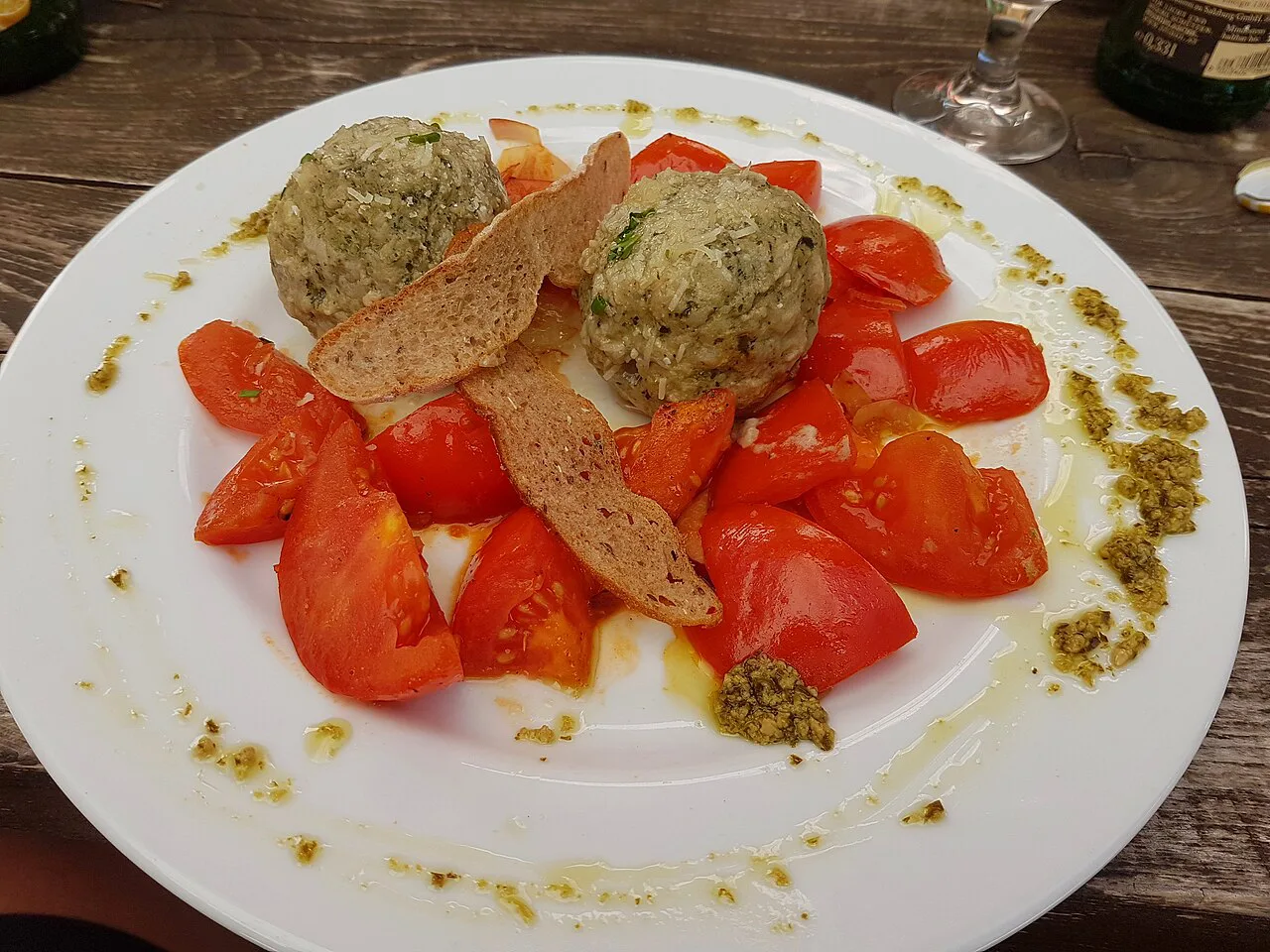
Canederli, called Knödel in German, are the Tyrolean dumpling: large gnocchi-like balls made from bread, milk and eggs, unrelated to Chinese dumplings despite the shared English name. They come in several flavours, the most popular being cheese, speck, mushroom, spinach or liver, and they are served either in broth or alongside goulash. Order them as a starter in broth if you want a lighter opening, or with goulash if you want the full mountain plate.
What languages are spoken in South Tyrol? South Tyrol is officially bilingual, with Italian and German used side by side in daily life. That is why menus, signs and hut names often appear in both languages, and why the same dish can have an Italian and a German name.
What is Tyrolean food? Tyrolean food is the Alpine cooking of the historical Tyrol, which includes South Tyrol and the Austrian Tyrol. Its staples are bread dumplings, filled pasta, smoked pork, stews, game and apple pastries, shaped by Austro-Hungarian cooking rather than by the Mediterranean kitchen.
The dumpling idea runs through the region's cooking as a way of making the most of stale bread, and the same instinct produces other bread-based dishes on local menus. The names change from valley to valley and from menu to menu, so match the German and Italian terms before you decide. A plate of two or three is usually enough before a main course, and they are filling.
Crafuncins (Schlutzkrapfen): spinach and ricotta-filled pasta crescents
Crafuncins, also written Schlutzkrapfen in German and Mezzelune in Italian, are bite-sized pasta crescents filled with spinach and ricotta. They are boiled, then finished with melted butter and grated parmesan, which makes them a rich first course rather than a light one. The name Mezzelune simply means half-moons, so if you see it on a menu, this is the dish.
The spinach-and-ricotta filling is a classic pairing in this part of the Alps, and the crescents sit alongside other filled pasta shapes in the regional repertoire. If you want a break from dumplings at the start of a meal, this is the alternative. Ask for them as a primo (first course), not a side.
Speck and Schüttelbrot: the smoked, aged pork and the hard spiced bread
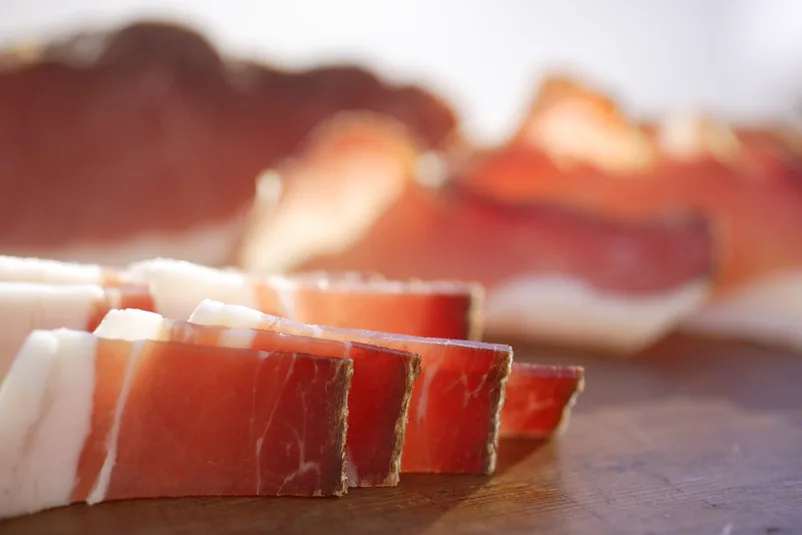
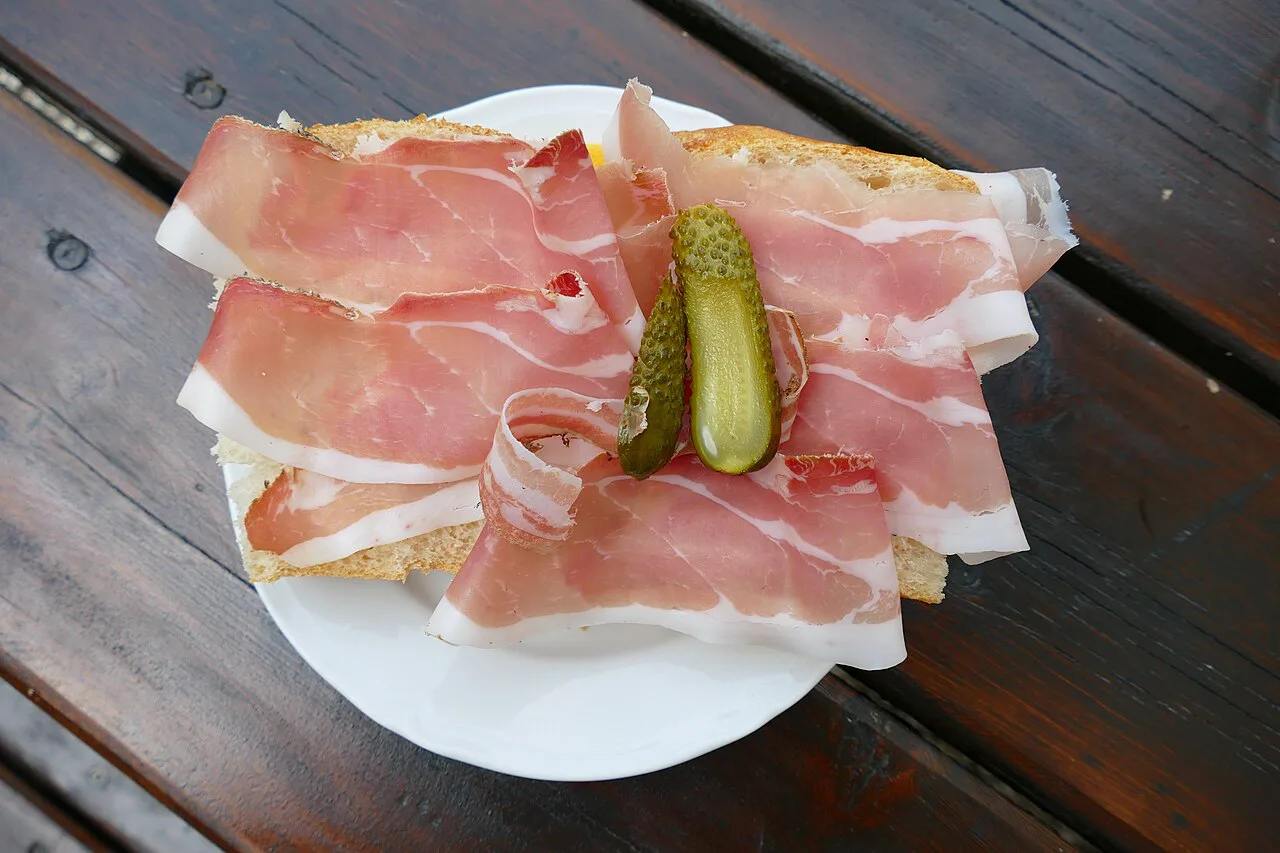
Speck may be South Tyrol's most famous culinary product: a pork cut that is spiced, smoked and then aged. The best way to eat it is cut into little strips with Schüttelbrot, a hard, spiced bread that is just as typical of the region. Speck and Schüttelbrot have been the favourite afternoon snack here for centuries, and they are what to order when you want something small with a drink rather than a full meal.
Speck also appears inside other local dishes, including some of the dumpling fillings, so you may meet it more than once in a single meal. The same cured-meat tradition runs down into Friuli, where Prosciutto di San Daniele DOP is the local speciality, and across the border into the Veneto, but the smoked, aged South Tyrolean version is its own thing.
Goulash, barley soup and game: the hearty stews, soups and venison, stag and boar
Goulash, Gulasch in German, is a hearty meat stew popular all over the Alps, and every chef has a own recipe; it goes well with polenta or spätzle. Barley soup, Zuppa d'Orzo or Gerstensuppe, is a local favourite often eaten as an entrée and most frequently in autumn, though it appears on menus year round. Both are the kind of dish to order at lunch after a morning outdoors, when you want something warm and substantial rather than refined.
Game is everywhere on the region's menus, thanks to the surrounding mountains and forests. You will mostly find deer, capriolo or Reh, and stag, cervo or Hirsch, and sometimes boar, cinghiale or Wildschwein; the rarest is chamois, camoscio or Gams, which usually appears only as salami or in Kaminwurz, a smoked sausage. If you see Selvaggina or Wild on the menu, it means game.
Spätzle, small egg noodles, turn up alongside goulash and with speck and cream, which is why the cooking of this region reads as rich and robust. The overall impression is of mountain food built for appetite, not delicate plates.
Strudel and kaiserschmarrn: the apple pastry and the shredded pancake dessert
Strudel is one of the best-known desserts of the Alps: a layered pastry filled with cooked apples, raisins and cinnamon, though recipes vary. It is usually served with powdered sugar and vanilla sauce. Order it at the end of a mountain lunch, when you want something sweet but not heavy.
Kaiserschmarrn is the other local favourite: essentially a broken-up pancake sprinkled with powdered sugar and eaten with raisins and berry jam. It is simple but rich, and the name plays on Kaiser, emperor. If you are sharing, one portion between two is usually plenty after a dumpling course.
How to read a menu: Italian and German names for the same dish
Menus in South Tyrol often give the same dish under two names, one Italian and one German, which is why the local tourist board lists both. Canederli are Knödel, crafuncins are Schlutzkrapfen or Mezzelune, and barley soup is Zuppa d'Orzo or Gerstensuppe. Knowing the German name matters in the mountain huts, where the German version may be the only one printed.
Menus, signs and hut names often appear in both Italian and German, so the two names for a dish may sit side by side. If a dish is unfamiliar, ask what it contains rather than guessing from the name.
Ordering and paying in a mountain hut or valley restaurant
Traditional dishes are served in most restaurants in Val Gardena and in the mountain huts around the valley, and some venues specialise in local cuisine. The hut setting is part of the meal: expect hearty portions and a casual room rather than a formal dining room.
In the valley restaurants and huts, order a primo and a secondo as the Italians do, or choose a single plate of dumplings or goulash if you are not very hungry. Speck with Schüttelbrot is the thing to ask for with a drink in the afternoon. If you are used to southern Italian menus, do not expect antipasto, pizza and pasta to carry the meal; the local dishes are the point here.
Where to eat: a mountain farm and the valley's local-cuisine restaurants
For the most authentic version of the local dishes, head to Paratoni, an old mountain farm in Val Gardena that the local tourist board names as a place to eat traditionally. It is the kind of farmstead setting where the region's cooking makes sense: bread, speck, cheese and dumplings in a mountain room.
In the valley's towns and villages, restaurants and huts serve the same repertoire of dumplings, goulash and game. Ask for the local specialities rather than the international dishes on the menu; the regional dishes are the reason to eat here. The South Tyrol tourism site also lists regional specialities across the province.
Dishes to know if South Tyrol is your first stop in Italy
If you cross into Italy here from Austria or Germany, the first meal will not match the Italian food you know from the south. Expect bread dumplings, smoked pork, stews and apple pastry rather than olive oil and tomatoes, and judge the region on its own terms. The cooking of the neighbouring Veneto, with its own rice dishes and seafood, is a different tradition again.
For a comparison, southern kitchens such as Sicily's use very different ingredients and a different set of street foods, including pani câ meusa and pasta with sardines. That contrast is useful: it shows how much a single country's cooking changes with the mountains and the border. If you are continuing south, read up on Sicilian Food before you go.
Which South Tyrol dishes should you order first?
Start with canederli in broth or crafuncins with butter and parmesan, then have speck and Schüttelbrot as an afternoon snack. For a main, choose goulash with polenta or spätzle, or a game dish if it is on, and finish with strudel or kaiserschmarrn. That order gives you the range of the region's cooking in a day or two.
Eat in mountain huts and valley restaurants that specialise in local cuisine, and treat the German names on the menu as a guide rather than a barrier. For more on the surrounding regions, see our guide to Regional Italian Food.
Explore more Italy food guides
Frequently Asked Questions
What languages are spoken in South Tyrol?
South Tyrol is officially bilingual, with Italian and German used side by side in daily life. That is why menus, signs and hut names often appear in both languages, and why the same dish can have an Italian and a German name.
What is Tyrolean food?
Tyrolean food is the Alpine cooking of the historical Tyrol, which includes South Tyrol and the Austrian Tyrol. Its staples are bread dumplings, filled pasta, smoked pork, stews, game and apple pastries, shaped by Austro-Hungarian cooking rather than by the Mediterranean kitchen.
Sources
Notes for your next meal in Italy
Optional updates to our food guides.
You might also like
Continue reading
More guides you'll find useful