Italian Seafood: Dishes to Order by Coast
A practical guide to Italian seafood, coast by coast: the dishes to order, what each one is, and how to read a menu without landing on a tourist trap.
On this page
The dish to order depends on which coast you are standing on: tuna and swordfish in Sicily, shellfish on the Neapolitan coast, brodetto along the Adriatic, and soft-shelled crab in the Venetian lagoon. Italian seafood cooking is judged on freshness and restraint, and the best plates taste of olive oil, garlic, parsley, white wine and tomato rather than of a heavy sauce. This guide sorts the dishes by coast, explains what each one is, and hands you the menu vocabulary you will actually meet.
What Italian seafood cooking is built on
Italian seafood is usually cooked plainly, with the fish allowed to lead. The base is olive oil, garlic, parsley, white wine or tomatoes, and the ingredients are treated as a way of carrying the flavour of the sea rather than masking it. If you are comparing cities to plan your eating, The Best Food Cities in Italy, and the Dishes to Order in Each is the place to start.
This is why freshness decides the meal. Fish is traditionally bought from fishmongers, and in places such as Venice people buy straight from the source, so a short menu of what is in season says more than a long one that offers everything. A plate that tastes mainly of tomato and chilli tells you less about the kitchen's fish than a plainly dressed one does.
The south and the islands: tuna, shellfish and two coastlines
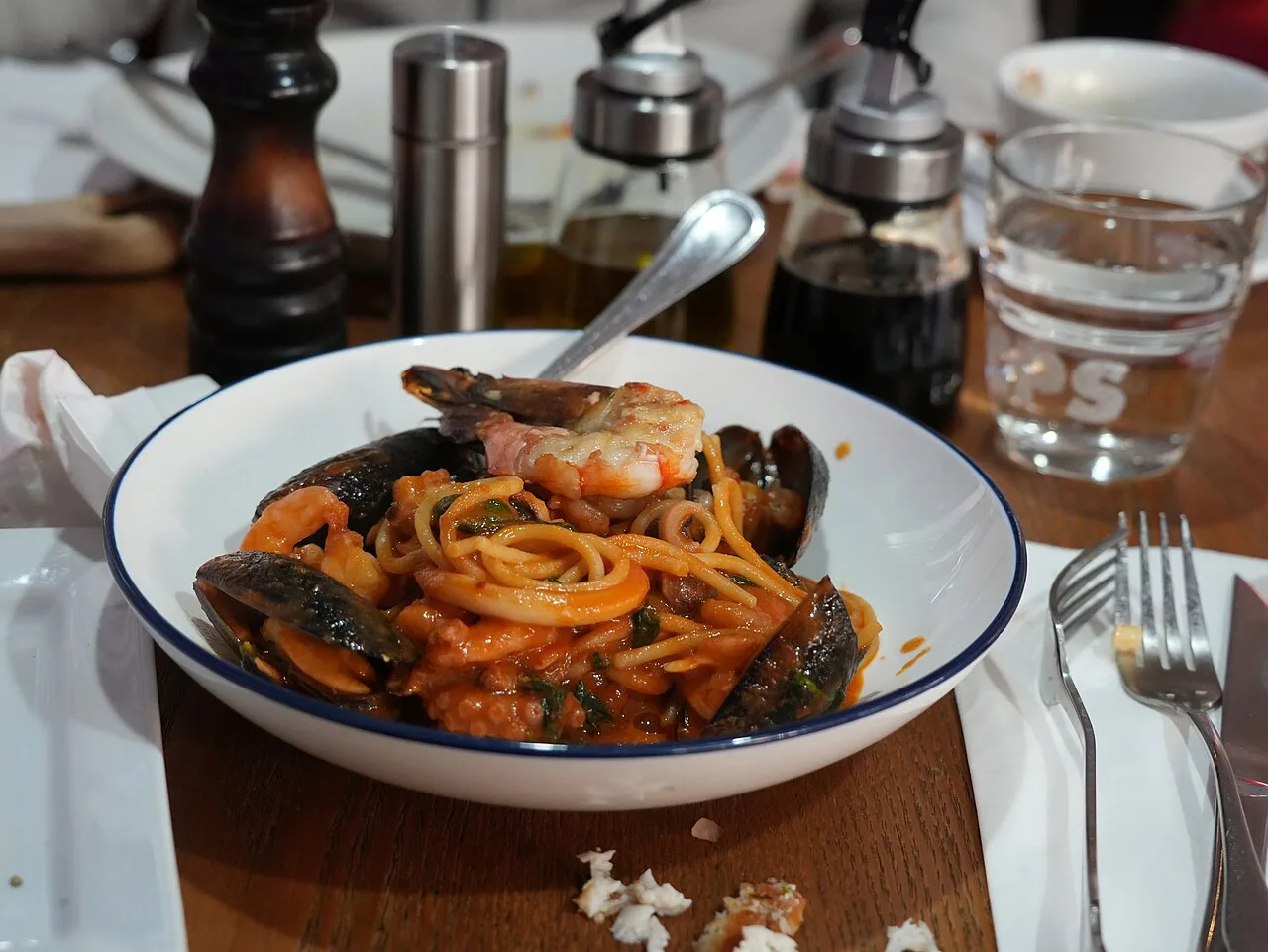
Sicily is known for its tuna, and the island's cooking treats it as a serious ingredient rather than a cheap filler. The Neapolitan coast, where Gino D'Acampo grew up, is known for its seafood, with prawns and shellfish leading the menu in everything from a simple pasta to a seafood soup. Calabria has two coastlines, so it draws on fish from both sides, and local loyalty to specific specialities is strong.
What is the difference between brodetto and cioppino? Brodetto is an Italian regional fish stew built from the day's catch, usually cooked in a tomato base and served with bread. Cioppino is an Italian-American stew that originated in San Francisco with Italian immigrant fishermen, made with whatever seafood is available and a tomato-wine base seasoned with fennel, garlic and red pepper flakes.
What does alle vongole mean on a menu? Alle vongole means with clams. It describes a dish dressed with clams, usually with olive oil, garlic and parsley, rather than a cream sauce.
Is fritto misto a starter or a main? Fritto misto is normally a main course: a mixed fry of small fish and shellfish in a light batter, served hot with lemon. It should be crisp rather than greasy.
In practice this means ordering what the coast is known for, and in Sicily that starts with tuna. The cooking in the south is often close to the recipe a family has cooked for generations: if the menu reads like a list of sauces rather than a list of fish, you are probably looking at a kitchen that buys in rather than choosing the catch.
The Adriatic side: Le Marche and its seafood
Le Marche is known for its Adriatic seafood, drawing on the catch of the day. A regional fish stew is a way of using mixed fish, so its exact contents shift with what is landed rather than following a fixed recipe. That flexibility is the point: it is a method for cooking the day's catch, not a single defined dish.
A coastal fish stew is generally stewed fish in a tomato base, often with bread to mop the bowl. It suits a shared table, and it rewards asking what is in it today, since the contents follow the catch rather than a fixed list.
The north: Ligurian fish stew and the Venetian lagoon
Liguria has its own fish stew, made with prawns and whatever fresh fish is in season, and it is simple rather than elaborate. Venice is known for preparing soft-shelled crab, a lagoon speciality. Both are examples of seafood at its plainest, built on a few ingredients and a short cooking time.
Baccalà, salt cod, is a preserved fish rather than a fresh one, so it keeps well and is forgiving when the fishing has been poor. It appears in Italian home cooking in many forms, and ordering it alongside fresh fish rather than instead of it gives you both sides of the kitchen.
Shellfish dishes: mussels, clams and prawns
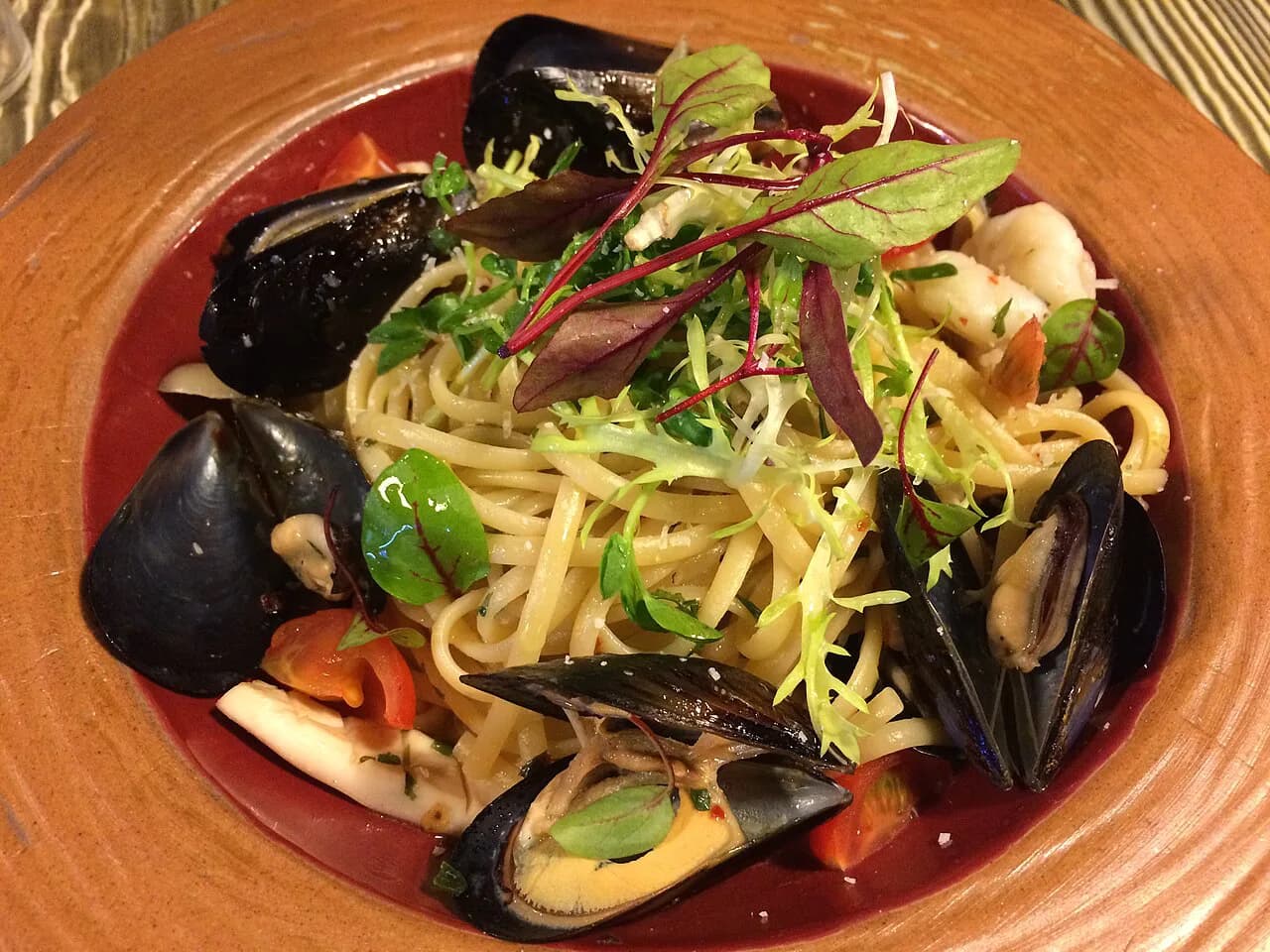
Shellfish is where Italian seafood becomes a pasta course. Mussels and clams are usually cooked with white wine, garlic and parsley, or with tomato; prawns are paired with pasta or served grilled. The sauce should stay light so the shellfish does the talking rather than a heavy cream one.
The rule of thumb is that the shellfish should be the main event, with the pasta as a carrier. A generous plate of clams or mussels in a shallow bowl is the right shape for a good version. If you see a creamy brandy sauce with prawns, such as the tagliatelle con gamberi e brandy Gino D'Acampo cooks, that is a different style of cooking and not a bad one, just a richer meal than a simple plate of shellfish.
Seafood with pasta or without: which to choose
Order seafood with pasta when you want a full plate of food, and seafood without pasta when you want to taste the fish itself. A plate of clams with spaghetti feeds a hungry person cheaply; a grilled fish feeds someone who cares about the texture and flavour of the catch. For a table of two, the neat move is one pasta dish with shellfish and one plain fish, then share both.
If you are travelling to learn the cooking as well as eat it, cooking classes in Italy are worth planning into a coastal stay.
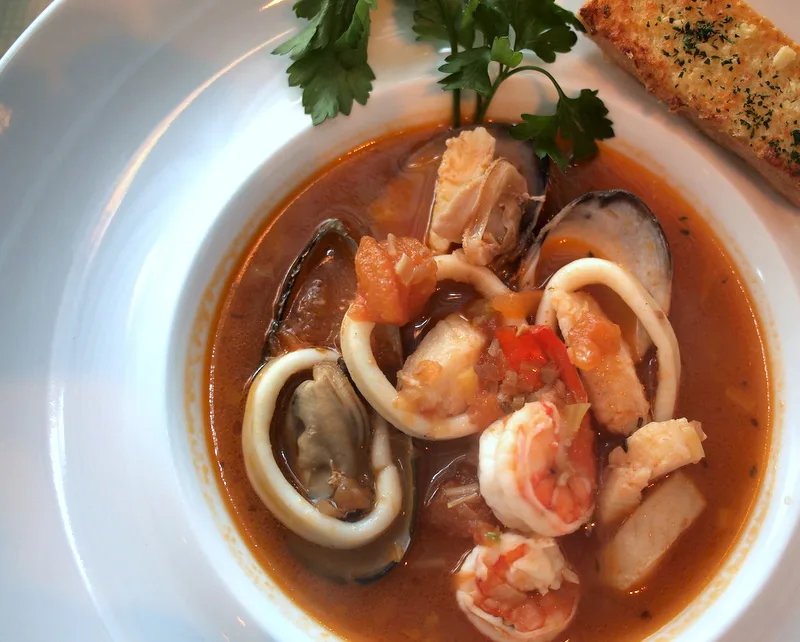
Seafood stew: brodetto, Ligurian stew and cioppino
Ligurian fish stew is an Italian regional dish: it is built around local fish, simply prepared with prawns and whatever fresh fish is in season. Cioppino is different. It is an Italian-American stew that originated in San Francisco, invented by Italian immigrant fishermen from whatever seafood they had that day, and its tomato-wine base is seasoned with fennel, red pepper flakes, onion and garlic rather than being a traditional Italian regional recipe.
The practical difference for a visitor is what to expect in a bowl. On an Italian coast, a fish stew is usually built from the day's catch, so the contents change with what is landed. Cioppino can take almost any seafood, from crab and clams to salmon and squid, and in Italy a menu using that name is borrowing an American idea rather than cooking a local one.
Fried and grilled seafood: fritto misto and alla griglia
Fritto misto is a mixed fry of small fish and shellfish in a light batter, eaten hot with lemon and bread. Alla griglia means grilled, usually with olive oil, lemon and parsley, and it is a good way to judge the freshness of a whole fish. Both work as a main course rather than a starter.
Order fritto misto when you want variety and grilled fish when you want one good ingredient. In a good kitchen, the grill is often the safer recommendation because there is nowhere to hide a tired fish under batter. Squeeze the lemon, add salt and oil to taste, and keep it plain.
Baccalà and salt cod on the menu
Baccalà is salt cod, a preserved fish that appears in Italian cooking in many forms and keeps well where fresh fish is scarce. If you see it on a menu alongside the daily catch, it is usually a sign of a kitchen that cooks Italian seafood beyond the obvious.
Treat baccalà as its own dish rather than a substitute for fresh fish. It is a good order when you want something savoury and rich, and it is forgiving when the fishing has been poor. If you have never eaten it, order it once alongside a simple grilled fish to compare the two styles.
How to read a seafood menu: gamberi and vongole
Two words worth knowing are gamberi, prawns, and vongole, clams; you will meet them across seafood menus from Liguria to the south. Learn a few of these terms and the menu stops feeling like a translation exercise. Alle vongole, for instance, signals a dish dressed with clams rather than with a cream sauce.
In some Italian seafood restaurants, fish can be sold by weight, so it is worth confirming the price of a whole fish for two before you order, because it can cost far more than a plate of pasta. As with any charge you are unsure of, ask before you commit to the order.
Ordering well: antipasto di mare, the market price and coperto
A mixed seafood starter of dressed shellfish and fish, shared at the table, is a good way to taste several things before choosing a main. Start there, then take a pasta or a grilled fish, not both unless you are splitting them. For a special occasion, Michelin Star Restaurants in Italy are another budget entirely, and worth comparing if you want one memorable seafood meal.
Ask whether fish is charged by weight and confirm the price before ordering rather than assuming the menu figure is final.
Italian seafood through the year
Italian seafood follows the season and the day of the week. Many coastal kitchens work to a short menu and take a weekly closing day, and in August some family-run restaurants take their holidays, so a carefully chosen trattoria can shut just as you arrive. Before you travel to a particular address, check that it is open when you plan to eat there.
Fish is central to many Italian celebration tables, so winter menus lean heavily on seafood in places where fish is a local speciality. If you are travelling around the winter holidays, Italian Christmas food will show you what to expect on the table.
Which coast are you eating on?
Start with the coast: order tuna in Sicily, shellfish on the Neapolitan coast, a fish stew on the Adriatic and soft-shelled crab in Venice. Then choose one pasta with shellfish and one plain fish, confirm the weight and price, and read the menu for gamberi and vongole before anything else. That combination will get you a good Italian seafood meal on almost any coastline.
If you want to plan around food rather than around sights, use The Best Food Cities in Italy, and the Dishes to Order in Each to decide where to eat, and save the special-occasion seafood meals for a booked table. The rest of the trip is best eaten simply, near the water, where the menu is short and the fish is fresh.
Explore more Italy food guides
Frequently Asked Questions
What is the difference between brodetto and cioppino?
Brodetto is an Italian regional fish stew built from the day's catch, usually cooked in a tomato base and served with bread. Cioppino is an Italian-American stew that originated in San Francisco with Italian immigrant fishermen, made with whatever seafood is available and a tomato-wine base seasoned with fennel, garlic and red pepper flakes.
What does alle vongole mean on a menu?
Alle vongole means with clams. It describes a dish dressed with clams, usually with olive oil, garlic and parsley, rather than a cream sauce.
Is fritto misto a starter or a main?
Fritto misto is normally a main course: a mixed fry of small fish and shellfish in a light batter, served hot with lemon. It should be crisp rather than greasy.
Where in Italy is tuna a speciality?
Sicily is known for its tuna, and it appears across the island's cooking rather than as a single dish. On the Neapolitan coast the focus shifts to shellfish such as prawns.
Sources
Notes for your next meal in Italy
Optional updates to our food guides.
You might also like

Continue reading
More guides you'll find useful