Italian Pasta Shapes: A Guide to Names, Forms and Sauces
A plain-English guide to Italian pasta shapes, from spaghetti and penne to orecchiette and strozzapreti, with what each name means and the sauce that suits it.
On this page
Italian pasta shapes are best understood as a set of design decisions: length, surface and hollow decide how much sauce each piece carries to your mouth. The names then tell you the size, since the suffixes shrink or enlarge a word, so penne means pens and the -oni ending in rigatoni signals something bigger. This guide decodes those names, separates dry from fresh pasta, and gives the sauce pairing that works for each family of shapes, from long strands to stuffed envelopes.
Along the way you will meet the regional specialities that actually turn up on menus in Liguria, Rome and Puglia, and see how pasta reaches the table in an Italian trattoria. Use it as a menu decoder rather than a rulebook: the pairings here are the ones that work, not laws Italians enforce at the pass.
What Italian pasta shapes are and why there are so many of them
Pasta is a dough of durum wheat flour and water or egg, rolled, cut, extruded or hand-shaped into forms that hold sauce in different ways. Durum wheat is the key: its high gluten content lets semolina dough be stretched into hundreds of shapes, and drying it gives a long shelf life. That combination of a stretchy dough and a storable product is the practical reason Italy ended up with such a variety.
The commonly quoted figure is around 350 Italian pasta shapes, though the same shape often carries different names from region to region. The naming itself follows a logic worth learning, because it lets you guess at an unfamiliar word. Masculine endings such as -elli, -ini and -etti and feminine ones such as -elle and -ine signal something small, while -oni and -one mean large, so spaghetti is literally little twines and spaghettini is finer still.
The story that Marco Polo brought pasta back from China is a popular one, and it is also inaccurate: pasta was already established in Italy by the time he made his voyage at the end of the 13th century. Some historians instead credit Arab groups with introducing pasta to Italy, along with the drying technique they had developed to preserve it on long journeys. Treat the precise route as a claim rather than settled history and enjoy the shapes themselves.
Dry pasta and fresh pasta: the difference and which shapes suit which
Dry pasta, pastasciutta, is made without egg, which gives it a firmer bite and a longer shelf life, and it is the everyday choice for robust sauces. Fresh pasta is typically made with flour and egg, producing a softer, silkier texture that lets delicate sauces and dairy-based ones show through. The practical upshot is a choice between bite and tenderness: dry pasta stands up to a heavy ragù, fresh pasta is better with butter, cream or a light cheese dressing.
What Italian pasta shapes are and why there are so many of them: Pasta is a dough of durum wheat flour and water or egg, rolled, cut, extruded or hand-shaped into forms that hold sauce in different ways.
Dry pasta and fresh pasta: the difference and which shapes suit which: Dry pasta, pastasciutta, is made without egg, which gives it a firmer bite and a longer shelf life, and it is the everyday choice for robust sauces.
Long shapes: spaghetti, linguine and tagliatelle: Long pasta is built for sauces that coat: the strands give a large surface area, and twirling them picks up a thin, clinging dressing.
The exception worth remembering is ragù alla bolognese, the rich meat sauce that traditionally goes with fresh egg pasta rather than dried. Many shapes exist in both forms, so tagliatelle and spaghetti can be bought dry or fresh, and restaurants often make their own fresh pasta in house. If a menu says pasta fresca, expect the softer texture and order accordingly.
Long shapes: spaghetti, linguine and tagliatelle
Long pasta is built for sauces that coat: the strands give a large surface area, and twirling them picks up a thin, clinging dressing. Spaghetti is the archetype, best with a simple marinara of plum tomatoes, olive oil, salt and basil, or with a garlic, oil and chilli sauce. Learning to twirl one or two strands on a fork, without a spoon, is the only technique you need.
Linguine is flatter than spaghetti and suits delicate seafood sauces, which is why the Neapolitan clam sauce linguine alle vongole is its natural partner. Tagliatelle and the wider pappardelle are ribbons, and contrary to common belief it is tagliatelle, not spaghetti, that is the right shape for a Bolognese ragù. The wider ribbons hold rich meat sauces better than thin strands.
Bucatini is the exception in this family: a thick tube with a hole through it, popular in Rome and built to trap sauce inside as well as around. It belongs with the city's gutsy pasta dishes, and it is one of the shapes worth ordering in Rome precisely because it is less common elsewhere.
Short shapes: penne, rigatoni, fusilli, farfalle and conchiglie
Short shapes work by trapping sauce in hollows, ridges or folds, which is why they suit chunky meat and vegetable sauces. Penne, named for the angled cut that resembles a fountain pen, is the most versatile of the group and holds thick tomato or meat sauces inside, and it is also the classic choice for baked dishes al forno. Rigatoni is a larger tube used in much the same way.
Fusilli are the spirals, and their grooves catch pieces of sausage or broccoli very effectively, which makes them a forgiving shape for dense sauces and simple ones alike. Farfalle, named butterflies and often called bow-ties, have a broad surface that carries cheese, tomato or meat sauces, and you will sometimes see them coloured green with spinach or black with cuttlefish ink. Conchiglie are shells, made for chunky meat, seafood or vegetable sauces, and the giant ones are sold for stuffing and baking.
Shells are the shape to reach for when a cheese sauce is involved, because the cup holds a creamy dressing instead of letting it slide off. In practice this means a cheese or ricotta sauce suits conchiglie and similar cup shapes, while a loose oil-based dressing is better on long strands.
Stuffed shapes: ravioli, tortellini and agnolotti
Stuffed pasta encloses a filling between layers of thin dough, and the shape usually signals what is inside. Ravioli are square or round envelopes, commonly filled with spinach and ricotta or finely minced meat, while tortellini are ring-shaped and said to resemble the navel of Venus, filled with smooth cheese or meat mixtures. Both are served in broth or a light sauce so the filling is not overwhelmed.
The stuffed family is where Italy's regional repertoire gets serious, and it is worth reading up on a shape before you order it. Piemonte has agnolotti, small pinched parcels of meat or vegetable filling, a shape that rewards a light butter and sage dressing rather than a heavy sauce. If you want to know what arrives on the plate and why, start with agnolotti and work outwards from there.
Emilia-Romagna contributes cappellacci, a larger stuffed hat shape, the sort of regional speciality that rewards ordering by name rather than asking for a generic ravioli. A menu that names the shape is usually telling you how it will be dressed, so use the name as your guide to the sauce.
Soup and small shapes: macaroni, orzo and fregola
Small shapes are made for broths, soups and bakes rather than for a plate of sauce. Macaroni is the familiar small tube, used in minestrone and in the baked dish the English-speaking world calls macaroni cheese, while orzo is a tiny rice-shaped pasta that works in soups but can also be used like rice in a pilaf or a salad.
Sardinia has its own small-format pasta, fregola, made by rubbing semolina dough into tiny toasted beads that are then cooked like a grain. It turns up in seafood dishes and soups around the island, and it is the shape to look for if you want to see how far the pasta form can be pushed.
Shape names in plain English: penne, farfalle, vermicelli, orecchiette and strozzapreti
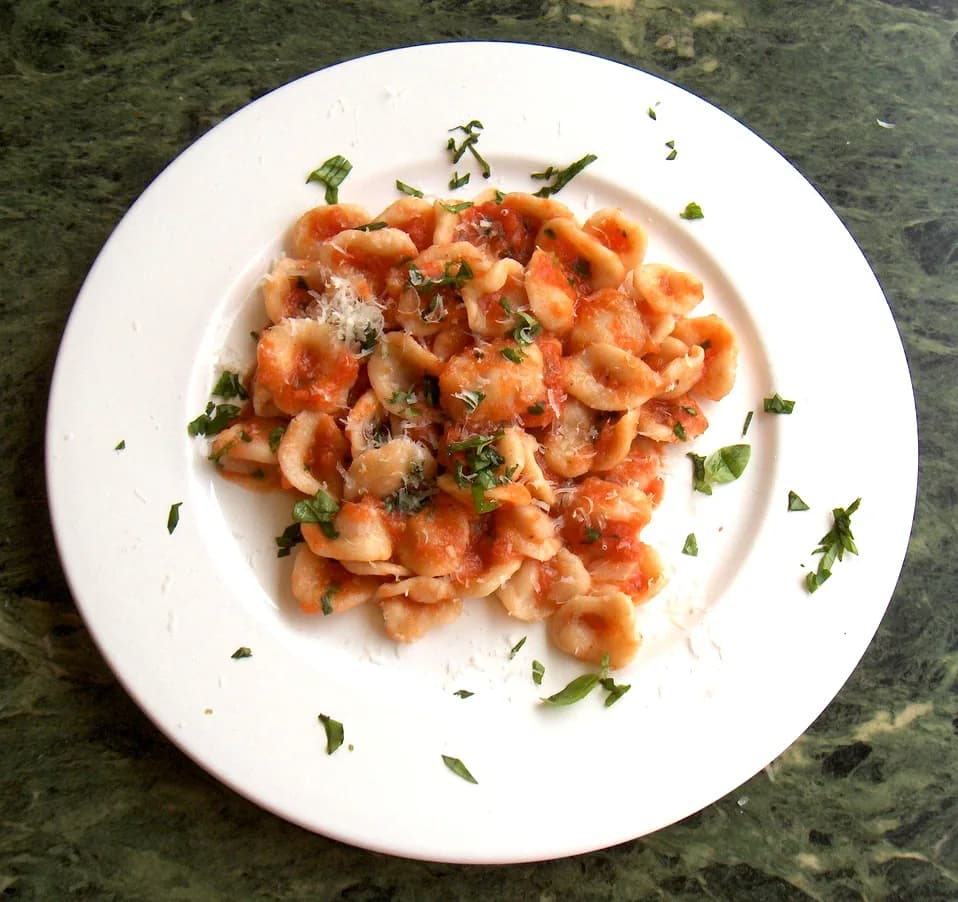
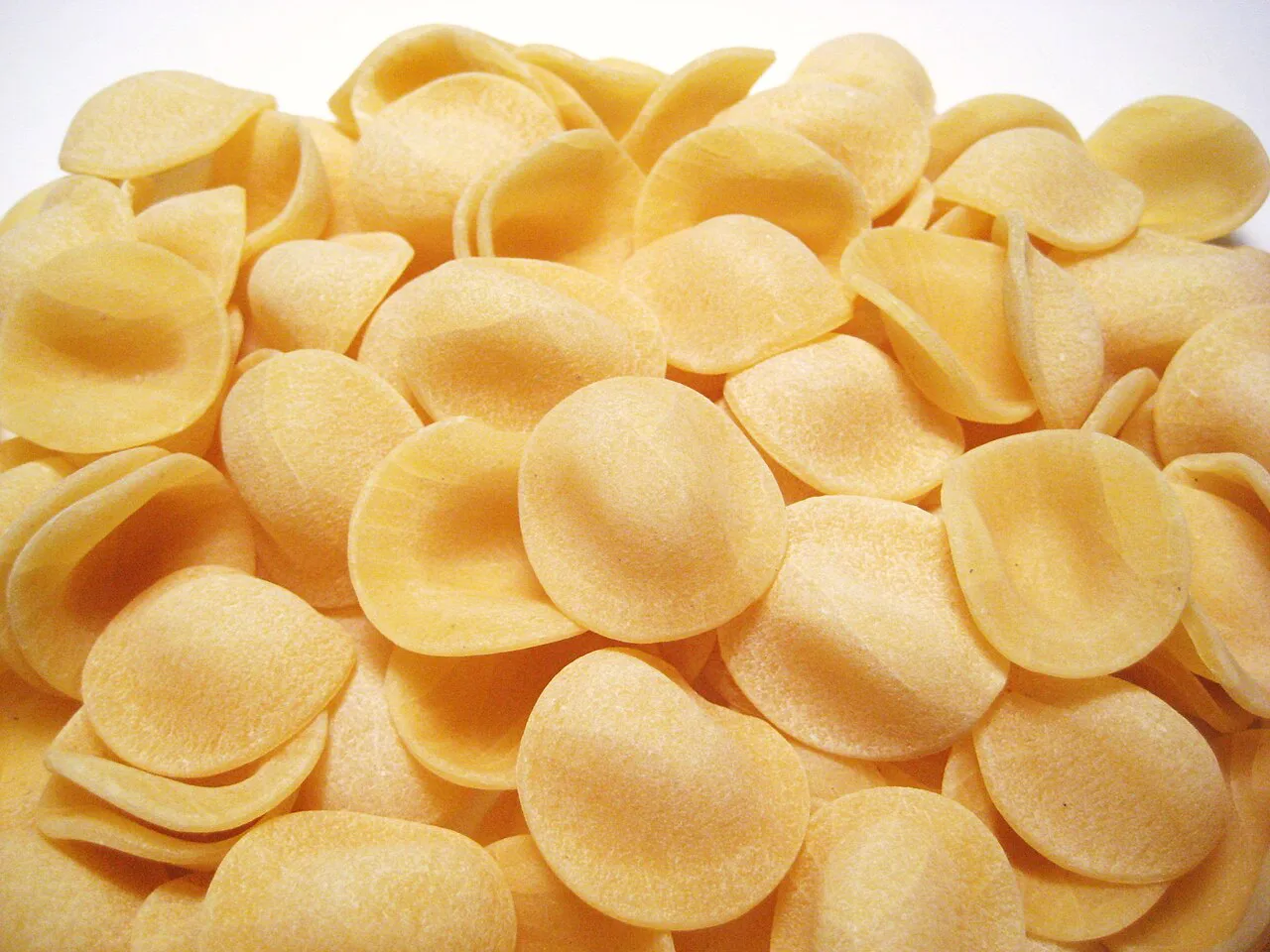
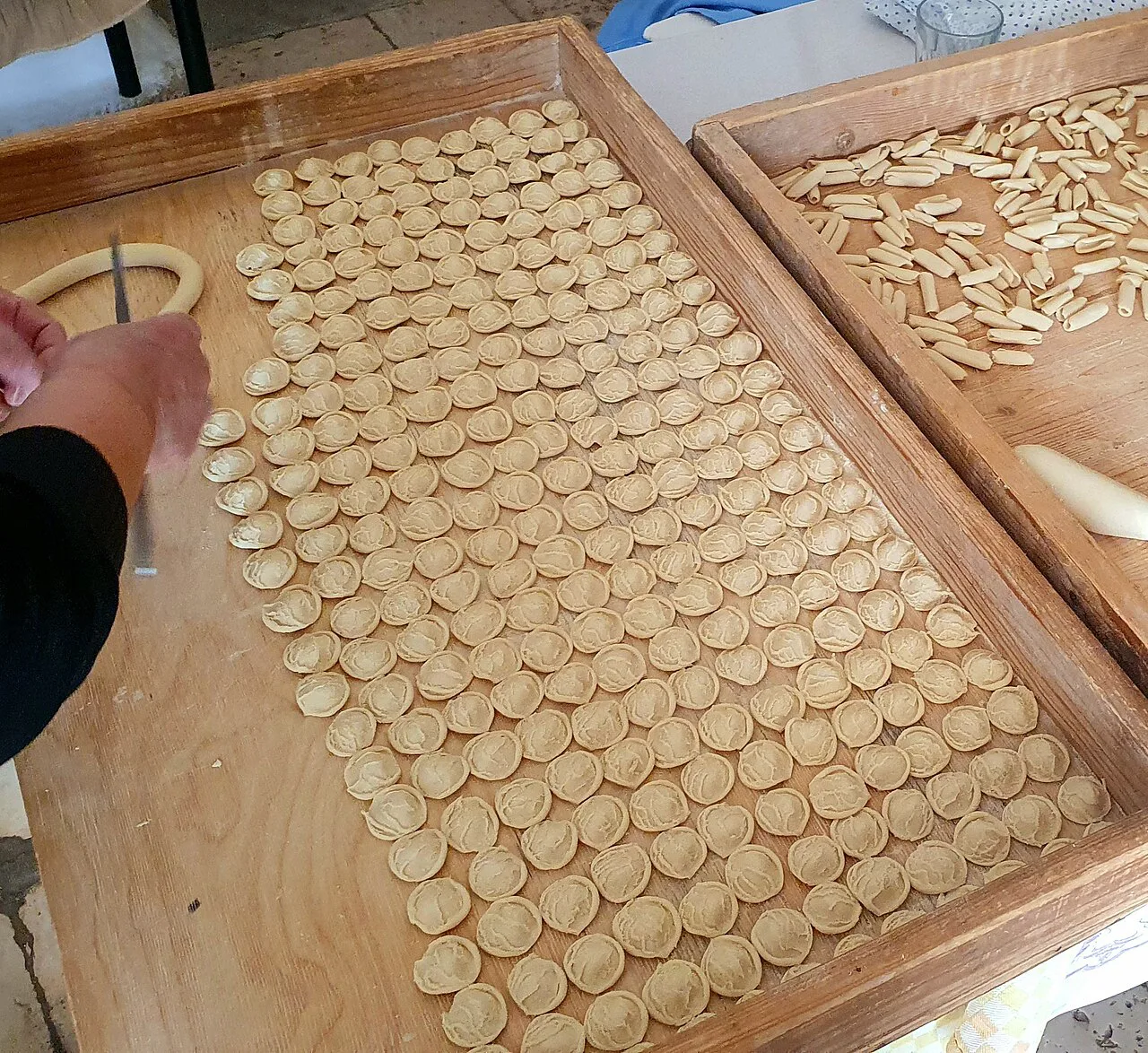
Most shape names are simply descriptions, which makes them easy to remember once you know the word. Penne means pens, farfalle means butterflies, and vermicelli means little worms, a name applied to any thin noodle that resembled them. Orecchiette from Puglia means little ears, and strozzapreti from Emilia-Romagna translates as priest strangler, a reminder that pasta naming has always had a sense of humour.
Once you know the suffixes and the plain meanings, an unfamiliar word on a menu becomes readable: the ending tells you the size, and the root often tells you the form. A shape ending in -etti will be small, one ending in -oni large, and anything named after an object will usually look like it. That is enough to order with confidence in a trattoria that uses local names.
Regional pasta: trofie in Liguria, bucatini in Rome and orecchiette from Puglia
Italian pasta is regional before it is national, and the shapes you meet depend on where you are. Liguria has trofie, short twisted pasta that is the natural partner for the region's homemade pesto, while Rome gives bucatini its home and Puglia gives orecchiette. Learning a region's shape is one of the fastest ways into its cooking.
Rome's contribution to the canon is more than one shape: the city's classic dishes include amatriciana, built on guanciale, tomato and pecorino, and it is worth knowing the dish before you order it. A pasta named on a Roman menu often tells you exactly which sauce is coming, so read the dish name rather than the shape alone.
Sardinia's culurgiones are a stuffed shape from the island's interior, closed with a distinctive braided seam and filled with potato and mint. They are the kind of regional speciality that rarely appears outside their home territory, which makes them a good reason to seek out Sardinian cooking when you are there.
Matching shape to sauce: the decision rules that work
The pairing logic is straightforward once you separate sauces by texture. Chunky meat and vegetable sauces go into tubes and grooved shapes where the pieces get trapped, while thin oil-based and seafood sauces go onto long strands that they can coat. Creamy and cheese sauces do best in cups and shells that hold the dressing, and stuffed shapes want broth or a light butter sauce so the filling stays the point.
The classic combinations illustrate the rule: pesto with trofie in Liguria, tagliatelle with ragù in Emilia-Romagna, and a cheese or ricotta sauce with shells. These pairings work because the sauce's texture matches the shape's surface, not because a committee approved them.
That said, there are no hard and fast rules for home cooking, and using whatever pasta is in the cupboard still produces a good meal. Read the pairings as a guide to what works best, especially when ordering in a restaurant, and as something you can bend at home.
How pasta is served in Italy: sauce tossed through, not spooned on top
In Italy the sauce is tossed through the drained pasta in the pan before serving, not ladled on top of a bare mound. This matters for the eating: the starch on the pasta helps the sauce cling, so every strand or tube arrives already dressed. If you are used to a pool of sauce sitting on the top, the Italian version will look drier and taste more even.
Portion size follows the same logic: pasta is often a first course, primo, rather than the main event, so a plate that looks modest is normal. Order a secondo after it if you want a full meal, and expect the pasta to arrive already seasoned rather than with a bowl of extra sauce on the side.
How to order pasta in a trattoria when you Don't know the shape
Read the dish name rather than the shape alone, because in an Italian trattoria the sauce is usually written into the name: amatriciana, alle vongole, al ragù. If a word is unfamiliar, apply the suffixes and the plain meanings, and ask whether the pasta is fresh or dried, since that single question tells you the texture you are getting.
Two practical questions do most of the work in a new city: what shape is the region known for, and which sauce is it served with here. Asking those in a trattoria is a normal conversation, not a tourist imposition, and it usually gets you a better plate than ordering the generic option. Cities with strong pasta traditions are worth planning around, and a look at the best food cities in Italy can help you decide where to head next.
Pasta is the heart of a Italian meal rather than an aperitivo snack, but the two connect: an aperitivo beforehand is a normal way to start an evening that ends with a plate of pasta. If you want to understand the rhythm of an Italian evening, the Italian aperitivo is a useful starting point before you sit down to eat.
Which shape should you order first?
Start with a shape that tells you what it does: tagliatelle with ragù if you want richness, spaghetti with a simple tomato or garlic sauce if you want clarity, and a stuffed shape in broth if you want to taste a filling. Then use the suffixes and plain meanings to decode the rest of the menu on your own.
In a new region, order the local shape with its traditional sauce rather than the international default, because that is where the cooking is most confident. Trofie with pesto in Liguria, bucatini in Rome and orecchiette in Puglia are the places to begin.
Explore more Italy food guides
Sources
Notes for your next meal in Italy
Optional updates to our food guides.
You might also like

Continue reading
More guides you'll find useful