Italian Truffles: Types, Seasons and How to Eat Them
Italian truffles explained: white Alba truffles, black winter and summer varieties, when each is in season, where they come from and which dishes to order.
On this page
Italian truffles are underground fungi that grow in partnership with tree roots, and Italy's most prized version is the white truffle from Alba in Piemonte. The country produces several distinct types across the year, so what you eat in January is rarely what you eat in July. This guide sets out the main varieties, their seasons, the regions they come from and the dishes where a few shavings earn their place.
Truffles are an expensive ingredient for two reasons: they cannot be reliably farmed, and they are found by trained dogs working tree by tree. The flavour is earthy and pungent rather than delicate, which is why a small amount goes a long way over eggs, buttered pasta or risotto.
What Italian truffles are and why they cost so much
A truffle is a strong-smelling fungus that grows underground among the roots of oak, hazel, pine and beech, and its quality depends heavily on soil and habitat. Truffles are ectomycorrhizal, meaning they share a symbiotic relationship with those host trees, which is why they are always found close to them.
Farming has barely been tamed. Attempts at cultivation succeed only on a limited scale in dedicated forests, and a planted sapling can take about seven years to produce its first truffle. Even then, hunters never know how many truffles they will find in a season, which keeps supply unpredictable.
The result is a clear hierarchy. White truffles sit at the top and command the highest prices, while black truffles are more widely available and considerably cheaper, though still an expensive ingredient by any normal measure.
White truffles: Tartufo Bianco d'Alba and Bianchetto
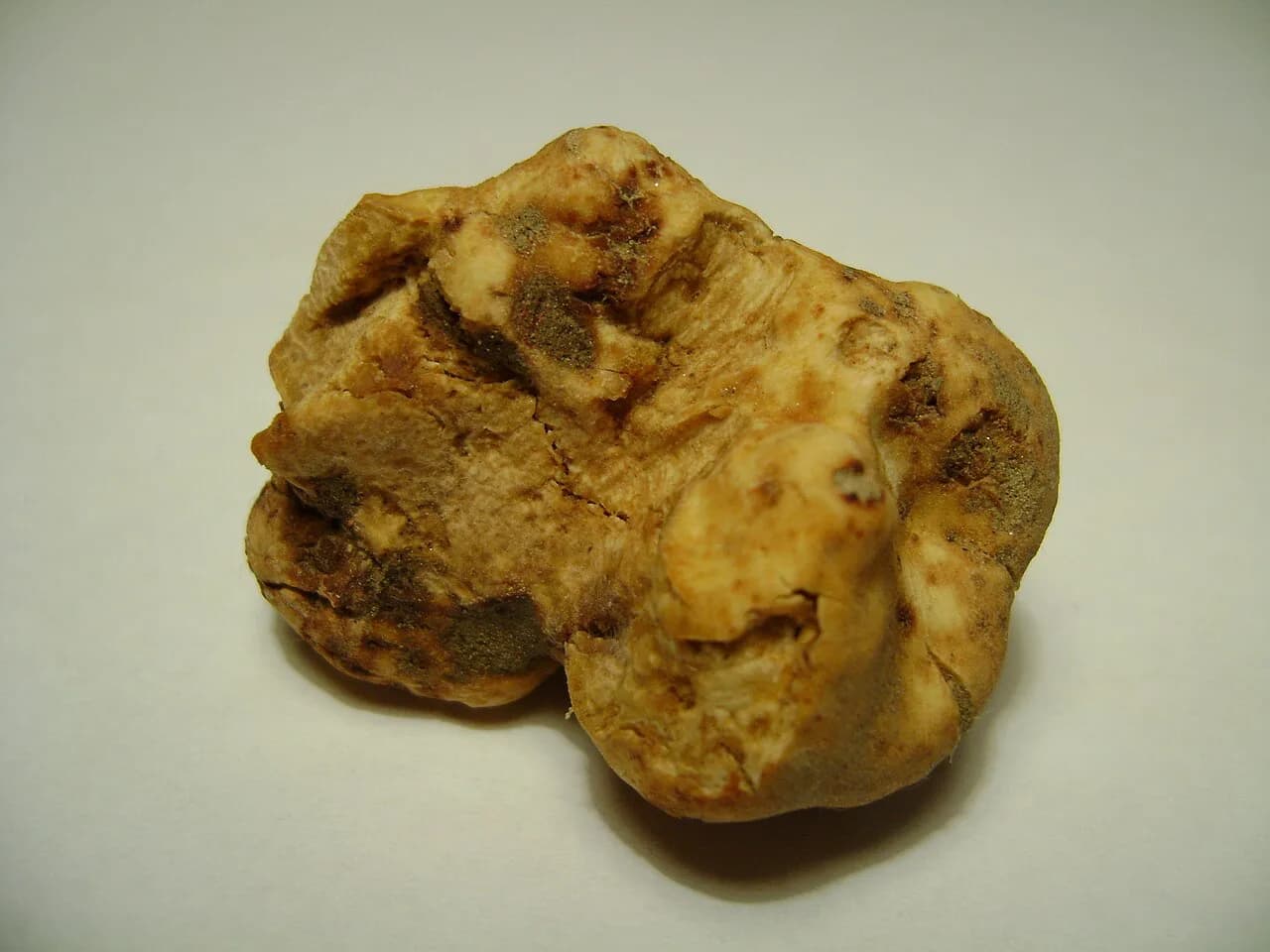
The Tartufo Bianco d'Alba is the most prized Italian truffle, high in demand among chefs and with a price to match. It looks a little like the contents of a large walnut, irregular and pale, and it comes from the hills around Alba in Piemonte. Piemonte, Tuscany, Emilia-Romagna and Abruzzo all offer the humid, cooler conditions truffles like, but Alba is the name most associated with the white type.
What are truffles called in Italian? Truffle in Italian is tartufo, plural tartufi. The main names you will see are tartufo bianco for white truffle, tartufo bianco d'Alba for the prized Alba type, tartufo nero for black truffle and scorzone for the summer black variety.
What do Italian truffles taste like? They are earthy, musky and intensely aromatic rather than spicy or sharp, with white truffles prized for perfume and black truffles for a deeper, more persistent flavour that holds up when cooked.
Bianchetto is the smaller white truffle, with its own growing season distinct from the Alba truffle. It carries the same family of aromas at a lower intensity and a lower cost, which makes it the practical entry point if you want to taste white truffle without the full Alba outlay.
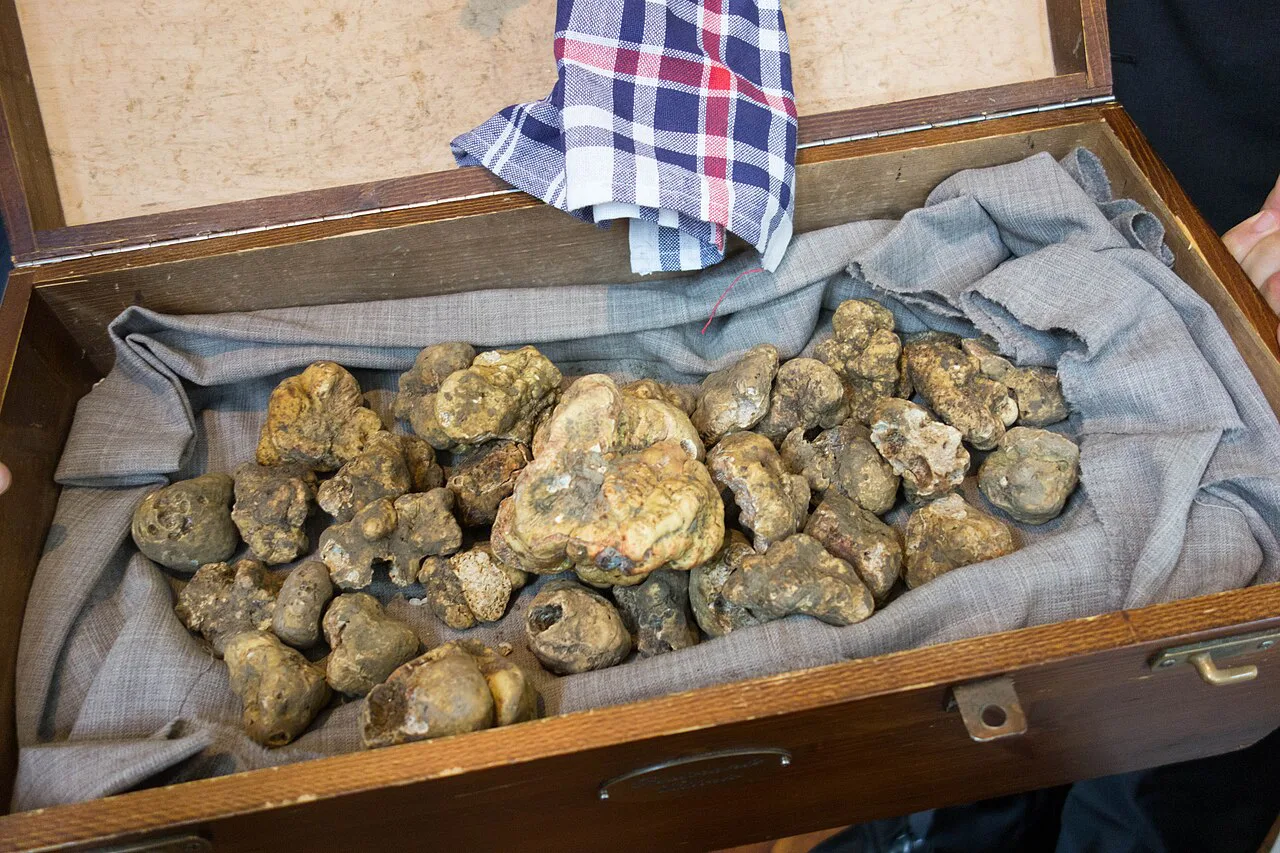
Black truffles: Pregiato, Nero d'Inverno and Scorzone
Black truffles are the broader, more affordable category, and the names to know are pregiato, nero d'inverno and scorzone. Pregiato, also called tartufo di Norcia after the Umbrian town, has a brown-red exterior despite the name and an intense flavour that puts it near the top of the black range. The best examples come from Umbria, but they are also harvested in Marche, Abruzzo and the Piemonte region.
Nero d'inverno, the black winter truffle, is harvested around the same period but has a bolder, more persistent flavour and tends to be smaller and more of a true black, with grey and white veining inside. It stands up well to hearty winter dishes and costs less than pregiato.
Scorzone is the summer black truffle, sold at lower prices than the winter varieties. Uncinato, another widespread black type, grows as far south as Lazio and Campania as well as in the cooler north, and its hardy exterior makes it suited to preservation.
Truffle seasons month by month
The Italian truffle calendar runs roughly as follows. Winter black truffles, including nero d'inverno, are harvested from November to February, while pregiato is gathered between mid-November and early March. That gives the colder months two strong black options and puts the deepest flavour in the year's coldest cooking.
White truffles are a short-window, winter ingredient. Depending on the type, they are gathered across the colder months, from the autumn into the new year, which is why they dominate menus in the depths of winter rather than at any other time. In practice, a dish described as al tartufo bianco belongs to the winter season even if menus vary from year to year.
Summer belongs to scorzone and bianchetto, lighter truffles that fill the gap when the prized winter varieties are gone. Because supply shifts with weather and woodland conditions, dishes and availability change from one season to the next, so what is on a menu in June is unlikely to be there in December.
Where Italian truffles come from
Alba in Piemonte is the reference point for white truffles. Umbria anchors the black side, with Norcia lending its name to the pregiato truffle, while Marche and Abruzzo contribute their own harvests.
Tuscany, Emilia-Romagna and Abruzzo provide the humid, cooler climate that truffles favour, and Tuscany in particular has a long association with both black and white types. If you are travelling for food and happen to be near Bologna or Parma, this is one more reason to eat in Emilia-Romagna in the autumn and winter.
What truffles taste like and how much flavour to expect
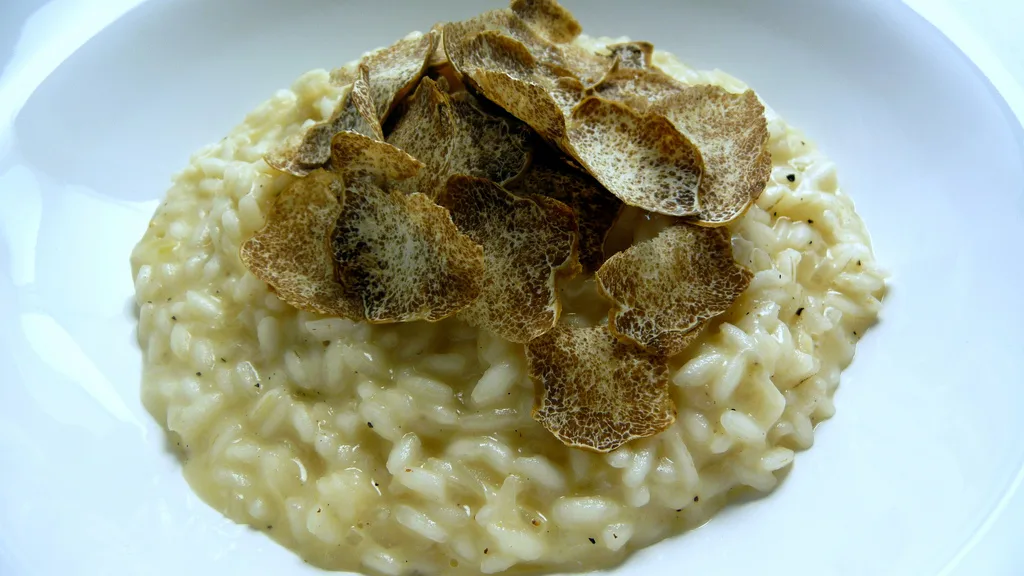
Truffle flavour is earthy, musky and strong on aroma rather than on heat or sharpness. White truffles are prized for that perfume and are used sparingly, often shaved raw at the table so the scent reaches you before the first bite.
Black truffles hold up better to heat; a few minutes in the pan brings out their flavour without destroying it. Their skins are slightly rougher, and peeling them delicately before shaving leaves you with trimmings that can go into sauces or stock.
Part of what you are paying for is scarcity and the difficulty of harvest, not just the taste. A menu that promises truffle without specifying which type is giving you very little to go on, so ask which truffle it is and whether it is fresh or preserved.
How truffles are hunted, with dogs rather than pigs
Truffles are found by scent, and the traditional method used pigs, whose sense of smell is excellent but whose appetite is a problem: they tended to eat what they found. Modern hunters work with trained dogs instead, less sensitive to the scent than pigs but willing to leave the truffle intact.
On a truffle hunt, the dog does the work and the handler reads its signals when it stops over a likely patch of ground. It is a walk through woodland rather than a guarantee of a find, and the catch goes to the hunter who brought the dog.
Dishes to order: tagliatelle, risotto, eggs and buttery pasta
The classic pasta partner is tagliatelle, egg-rich ribbons that carry shaved truffle without competing with it. Buttery pasta of any wide, flat shape works on the same principle: fat carries the aroma and the truffle does the rest.
Black truffle is excellent in a mushroom risotto or folded through a hearty winter braise, where its deeper flavour has something to push against. A small amount of a good grating cheese stirred in at the end adds the savoury background risotto needs.
Italian grating cheeses vary enormously in character, and a risotto or truffle pasta shows the difference plainly. Our guide to Parmigiano Reggiano — the raw-milk cheese made in the designated zone around Parma, Reggio Emilia, Modena and Bologna — unpacks how it is made, aged and graded, which is useful when a menu lists several grating options and you want to choose with confidence.
Eggs are perhaps the most direct way to taste truffle: fried or scrambled slowly, then covered with shavings just before serving. If you want to understand the ingredient rather than a sauce, this is the dish to order.
Fresh truffle versus truffle oil, cream and honey
Truffle-flavoured products are everywhere in Italy, from oil and vinegar to cream, honey and spirits, and the vast majority contain no fresh truffle at all. Truffle oil in particular is often made with artificial flavouring and pieces of cheap truffle added for appearance.
That does not make the products worthless, but they are not a substitute for the real thing. If you want the experience of fresh truffle, spend on a small amount of the real ingredient rather than on a jar of cream that mimics it.
Buying truffles and truffle products to take home
Fresh truffles are highly perishable and best treated as a short-notice purchase rather than a holiday souvenir to carry home weeks later. Preserved products are easier to carry, but read the label for truffle content rather than trusting a picture on the front.
In truffle country, markets and specialist shops sell fresh truffles in season, often weighed and priced on the spot; smaller shops are usually happy to advise on type and origin. Pair a purchase with local cheese, such as a slice of pecorino from the same region, and you have the makings of a simple, very good plate.
Which truffle should you try first?
If you want the full experience and are in Piemonte in winter, order a small portion of white truffle over eggs or tagliatelle and accept the price as the point of the exercise. For most travellers, a pregiato or nero d'inverno dish in Umbria or Tuscany gives a clearer idea of what truffle tastes like without the extreme cost of the white variety.
Outside the winter months, look for scorzone on menus rather than paying a premium for something described vaguely as truffle. Ask which type is in the dish, order the simplest preparation on the menu, and skip the truffle oil on the shelf in favour of the real thing in season.
Explore more Italy food guides
Frequently Asked Questions
What are truffles called in Italian?
Truffle in Italian is tartufo, plural tartufi. The main names you will see are tartufo bianco for white truffle, tartufo bianco d'Alba for the prized Alba type, tartufo nero for black truffle and scorzone for the summer black variety.
What do Italian truffles taste like?
They are earthy, musky and intensely aromatic rather than spicy or sharp, with white truffles prized for perfume and black truffles for a deeper, more persistent flavour that holds up when cooked.
Sources
Notes for your next meal in Italy
Optional updates to our food guides.
You might also like

Continue reading
More guides you'll find useful